

PREVIOUS
✖
Cauvery water issue
August 2 , 2026
22 days
1100
0
(இதன் தமிழ் வடிவத்திற்கு இங்கே சொடுக்கவும்)
- The Cauvery Water Management Authority (CWMA), at its meeting in New Delhi, endorsed the Cauvery Water Regulation Committee’s (CWRC) order.
- Cauvery Water Regulation Committee issued an order that Karnataka release 3,500 cubic feet per second (cusecs) to Tamil Nadu for 15 days.
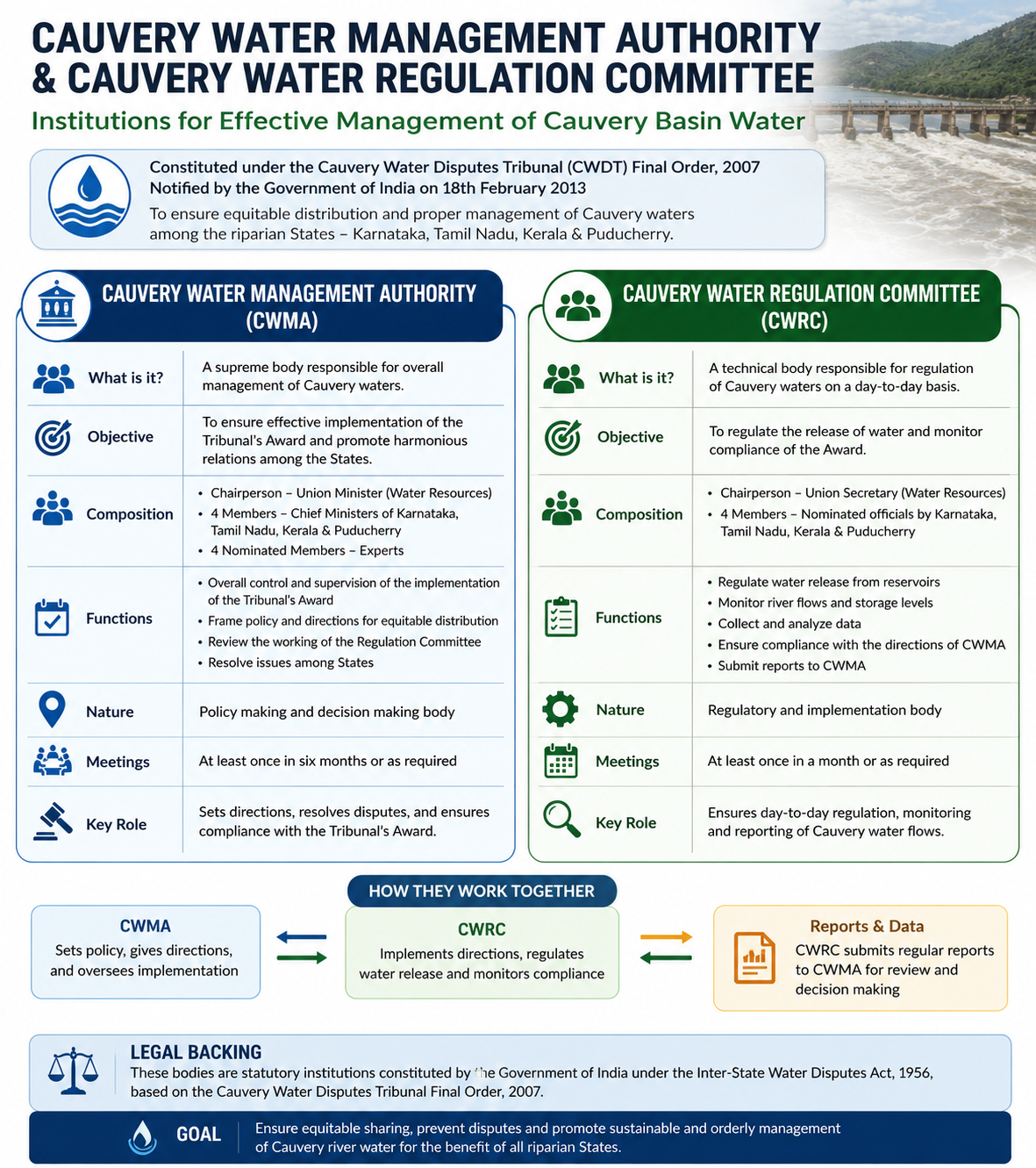
- The CWRC functions within the ambit of the Cauvery Water Management Authority (CWMA).
- CWMA constitutes the implementation mechanism for the final award (2007) of the Cauvery Water Disputes Tribunal as modified by the Supreme Court in 2018.
- The committee is headed by the Member (Water Resources) of the CWMA, and has as its members the Chief Engineers of all the basin constituents and a representative each of the India Meteorological Department, Central Water Commission, and Union Ministry of Agriculture and Farmers’ Welfare.
- According to a notification issued by the Union Jal Shakti Ministry in June 2018, the committee monitors daily water levels, inflows and storage at each of the reservoirs — Hemavathy, Harangi, Krishnarajasagara (KRS) and Kabini (all in Karnataka), Mettur, Bhavanisagar and Amaravathy (Tamil Nadu), and Banasurasagar in Kerala.
- It is to ensure 10 daily releases of water on a monthly basis from the reservoirs as directed by the authority. It is also to prepare seasonal — southwest monsoon (June-October 15); northeast monsoon (October 16-January 31) and hot weather (February-May) — and annual reports of the water account.
- The hydro-meteorological conditions prevailing in the Cauvery basin, including the rainfall recorded and the forecast or outlook for the ensuing fortnight, live storage position, inflows into and outflows from the eight reservoirs, and the realisation of flows at Biligundulu are reviewed and deliberated upon in detail.
- Karnataka’s four reservoirs within this basin are Krishnaraja Sagara, Kabini, Hemavathy and Harangi.
CWMA
- Established on June 1, 2018, the Authority was constituted as an implementation mechanism for the Supreme Court’s (SC) 2018 judgment and the final award of the Cauvery Water Disputes Tribunal (CWDT) of 2007.
- The key aspect of the judgment pertains to water allocation among the constituents of the Cauvery basin.
- Holding on to the total availability of water, 740 thousand million cubic (tmc) feet, in the basin during a normal year, as determined by the CWDT, the Court made the allocation for the constituents as follows: Puducherry (7 tmc ft); Kerala (30 tmc ft); Karnataka (284.75 tmc ft) and Tamil Nadu (404.25 tmc ft).
- Additionally, 10 tmc ft and 4 tmc ft were set aside for environmental protection and inevitable escapages into the sea.
- In the case of Karnataka, the Court allocated 4.75 tmc ft specifically to Bengaluru, which, it referred to as having attained “global status,” and the city’s drinking water requirement had risen multifold.
- Besides, the Court reduced Tamil Nadu’s original share, which was fixed by the Tribunal in the final order at 192 tmc ft, by 10 tmc ft and transferred that quantity to Karnataka. As a result, Karnataka’ share, which was determined by the CWDT as 270 tmc ft, increased by 14.75 tmc ft.
- One of the salient features of the Court’s verdict pertains to Karnataka’s commitment to Tamil Nadu.
- The upper riparian State is to ensure, at Biligundulu, located on the inter-State border, 177.25 tmc ft, as per a monthly schedule that is divided into blocks of 10 days each.
- Of this quantity, 123.14 tmc ft is to be provided during the period from June to September, also marks the monsoon.
- Invariably, it is during this period that the Cauvery issue flares up in times of poor rainfall, as has happened now.
- The Authority, headed by a full-time chairman, has two whole-time members dealing with water resources and agriculture.
- It consists of two part-time members drawn from the Union Ministries of Jal Shakti and Agriculture, apart from representatives of the four constituents of the basin.
- The Member-Secretary of the Authority is the chief of the Cauvery Water Regulation Committee (CWRC), which assists the CWMA in arriving at decisions.
- The Committee includes, among others, a representative of the Meteorological Department.
- The CWRC is required to meet once every ten days in June and October, and after the onset of the southwest and northeast monsoons, the frequency is at least once a fortnight.
- As for the Authority, there is no specific stipulation, but it invariably meets at the beginning of the water year (June-May) to determine the total residual storage in eight specified reservoirs and order water releases.
- It meets as and when required.
- Ordinarily, the CWMA’s meetings are preceded by meetings of the CWRC.
- The Union Ministry of Jal Shakti’s order of June 2018 provided for the constitution of the Authority.
- It states that “the Authority, through the Regulation Committee and with the help of the Central Water Commission, and other Central or State organisations as necessary, will identify situations of distress in the river basin.”
- Additionally, the order stipulates that in case of deficiency in water availability during any month, as reported by the Regulation Committee, the Authority will consider a reduction in the indent of the parties in proportion to the quantities allocated to each State by the Tribunal, as modified by the Supreme Court for the designated crops.
- The Regulation Committee shall monitor the actual performance of the monsoon at ten-day intervals and report to the Authority, indicating the extent of variation from the normal.
- The Authority, on receipt of such information, will consider any changes to the release ordered by them earlier, the communication points out, adding that a similar exercise will continue as the monsoon progresses during the succeeding months until the end of the water year [May 31].
- At present, there are no non-official members in the CWRC or the CWMA.
- There is a provision in the Union Ministry’s order for the Authority to co-opt the services of experts from Universities and other institutions by treating them as special invitees for its meetings.
- In addition to environmental specialists, representatives of farmers can be included by the Authority.
- Besides, the minutes of the deliberations of the CWRC and the CWMA should be published on a dedicated website for the Authority as early as possible.

Leave a Reply
Your Comment is awaiting moderation.