

PREVIOUS
✖
India’s Tiger Population in 2026
August 4 , 2026
21 days
1168
0
(இதன் தமிழ் வடிவத்திற்கு இங்கே சொடுக்கவும்)
- India has emerged as a global leader in tiger conservation through science-based policies and strong institutional support.
- Today, India is home to the world's largest wild tiger population, accounting for nearly 70% of all wild tigers globally.
- Rajasthan’s tiger population has increased to 149 across its five tiger reserves, with Ranthambore housing 72 of them.
- Ranthambore is among India’s most successful tiger reserves in terms of breeding and cub survival.
- Ranthambore’s tiger survival rate is around 80 per cent, among the highest recorded for major tiger reserves in the country.
- The legacy of the legendary tigress Machli (T-16) is regarded as one of Ranthambore’s most iconic tigers.
- During her lifetime, she gave birth to 18 cubs.
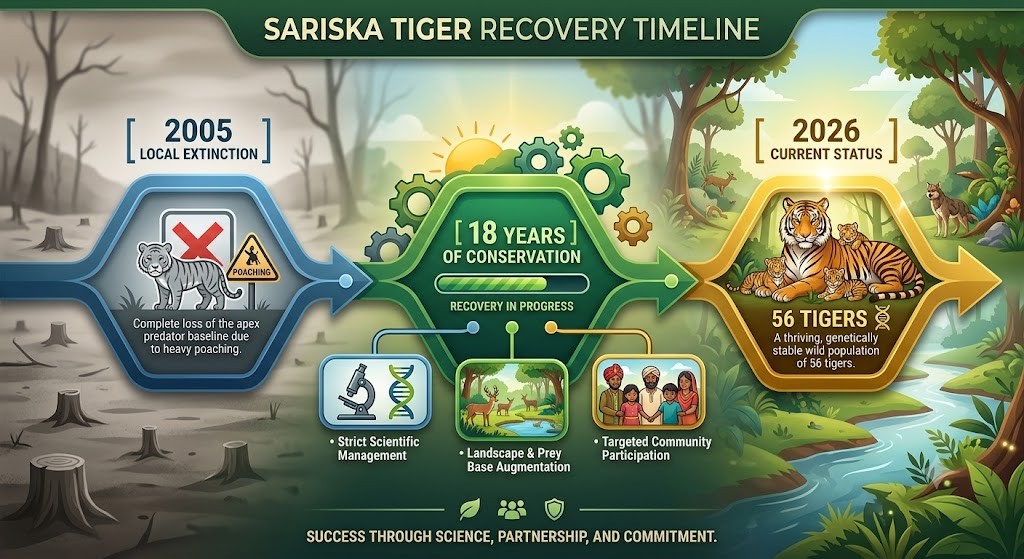
- When Sariska lost all its tigers in 2008, the reserve was repopulated using descendants of Machli from Ranthambore.
- Sariska Tiger Reserve achieved a historic milestone as the world’s first successful scientific relocation of tigers.
- Sariska, where tigers had once become completely extinct, is now home to 53 tigers.
- It is claimed as the world’s first successful scientific reintroduction of tigers.
- Madhya Pradesh, often called India’s “Tiger State”, has already reported 45 tiger deaths this year, about 40 per cent of the national total.
- Madhya Pradesh recorded the highest number of tigers at 785 in 2022.
- The NTCA records several causes of tiger deaths, including old age, territorial fights, electrocution, train accidents, poisoning and poaching.
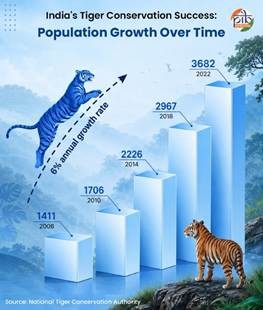
- The All-India Tiger Estimation (2022) covered 20 States places India's tiger population at 3,682.
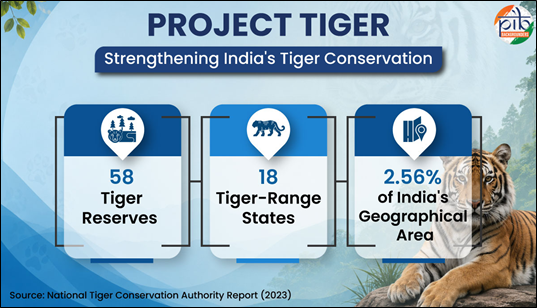
- Project Tiger has established a network of 58 tiger reserves across 18 tiger-range States.
- These reserves cover around 84,500 square kilometres, which is about 2.56% of India's geographical area.
- The Government of India declared the Royal Bengal Tiger as the National Animal in 1972.
- Project Tiger is a flagship Centrally Sponsored Scheme of the Government of India.
- It is implemented by the Ministry of Environment, Forest and Climate Change (MoEFCC).
- Wildlife Protection Act, (WPA), 1972 requires every State Government to prepare a Tiger Conservation Plan for each tiger reserve.
- Some significant amendments were made into the Wildlife (Protection) Act in 2006.
- The amendments established the National Tiger Conservation Authority (NTCA) and the Wildlife Crime Control Bureau (WCCB) as statutory bodies.
- NTCA is chaired by the union minister for Environment, Forest and Climate Change.
- NTCA oversees the implementation of Project Tiger and related conservation initiatives.
- India's tiger reserves follow a landscape-based conservation approach.
- Each reserve includes a Core Area (also known as Critical Tiger Habitat) and a Buffer Area.
- Core Areas receive the highest level of protection.
- Buffer Areas balance conservation with sustainable livelihoods.
- Also, Wildlife corridors connect tiger reserves, enabling safe movement and maintaining healthy tiger populations across landscapes.
- International Tiger Day traces its origins to the Saint Petersburg Tiger Summit held in November 2010.
- Leaders from 13 tiger-range countries, including India, adopted the ambitious Tx2 goal to double the global wild tiger population by 2022.
- The Global Tiger Recovery Program is an international alliance launched in 2010 to double wild tiger numbers, improve habitat management, and stop illegal poaching.
- It was started by the World Bank through the Global Tiger Initiative at the 2010 St. Petersburg Tiger Summit.
- First Phase (2010–2022): Focused on the TX2 goal to double wild tiger populations, which nations like India successfully achieved.
- GTRP 2.0 (2023–2034): Launched on July 29, 2023, via the Global Tiger Forum to fix new problems like human-wildlife conflict and weak local governance
- AITE is the world's largest biodiversity survey.
- Conducted every four years, it is led by the NTCA in collaboration with the Wildlife Institute of India (WII).
- The 2022 assessment also included India's first nationwide survey of ungulates.
- The exercise highlighted the importance of healthy prey populations for sustaining viable tiger populations.
- The All-India Tiger Estimation is recognised as the world's largest biodiversity survey.
- The NTCA's camera trap survey also holds a Guinness World Record as the world's largest camera trap wildlife survey.
- The Monitoring System for Tigers – Intensive Protection and Ecological Status (M-STrIPES) uses GPS, GPRS and remote sensing technologies for field monitoring.
- The Camera Trap Data Repository and Analysis Tool (CaTRAT) automatically classify camera trap images by species.
- ExtractCompare identifies individual tigers using their unique stripe patterns. Collectively, these tools improve the accuracy and reliability of tiger population estimates.
- International Big Cat Alliance (IBCA) is a global coalition of 95 big cat range and partner countries, scientific organisations and conservation partners.
- The Alliance promotes cooperation for conserving seven big cats—tiger, lion, leopard, snow leopard, cheetah, jaguar and puma.
- Introduced in April 2023 during the 50th-anniversary celebrations of India's Project Tiger - headquarters of the alliance is located in New Delhi.
- GTF – Global Tiger Forum is the world's only intergovernmental organisation dedicated exclusively to tiger conservation.
- Headquartered in New Delhi, it brings together 13 tiger range countries-Bangladesh, Bhutan, Cambodia, China, India, Indonesia, Lao PDR, Malaysia, Myanmar, Nepal, Russia, Thailand and Vietnam.
- Integrated Tiger Habitat Conservation Programme (ITHCP) is the International Union for Conservation of Nature's (IUCN) flagship tiger conservation initiative.
- It is funded by the German Government through KfW Development Bank.
- The programme supports science-based conservation projects across priority tiger landscapes in Asia.
- Conservation Assured Tiger Standards CA|TS is a global certification system that ensures effective management specifically of tiger conservation areas.
- It was launched at the 1st Asian Parks Congress in Japan in 2013.
- CA|TS supports efforts to create safe, sustainable environments for tigers and preserve global biodiversity.
- CA|TS has accredited 23 Indian tiger reserves ensuring global best practices in conservation

Leave a Reply
Your Comment is awaiting moderation.