

PREVIOUS
✖
Tamilnadu Revised Budget 2026
August 14 , 2026
60 days
10708
0
- The debut Budget of the C. Joseph Vijay-headed Tamilaga Vettri Kazhagam (TVK)-led coalition government was presented by Tamil Nadu Finance Minister N Marie Wilson.
- It sought to strike a balance between fiscal prudence and welfare, with a focus on the empowerment of women, youth, students, and the elderly.
- The State Government is required to place a Medium-Term Fiscal Plan (MTFP) before the Legislative Assembly along with the Budget in accordance with the Tamil Nadu Fiscal Responsibility Act, 2003 (TNFRA).
- As per the said Act, the MTFP shall set forth a multi-year rolling target for the prescribed fiscal indicators like Revenue Deficit, Fiscal Deficit and Debt to GSDP ratio, specifying the underlying assumptions made to arrive at those projections.
- Complying with the said provisions under the Tamil Nadu Fiscal Responsibility Act, 2003, a Medium-Term Fiscal Plan for the period from 2026-27 to 2028-29 is hereby placed before the Legislative Assembly.
Overall Picture
- The budget is outlining a visionary roadmap to transform the state into a 1.5 trillion-dollar economy by the year 2031.
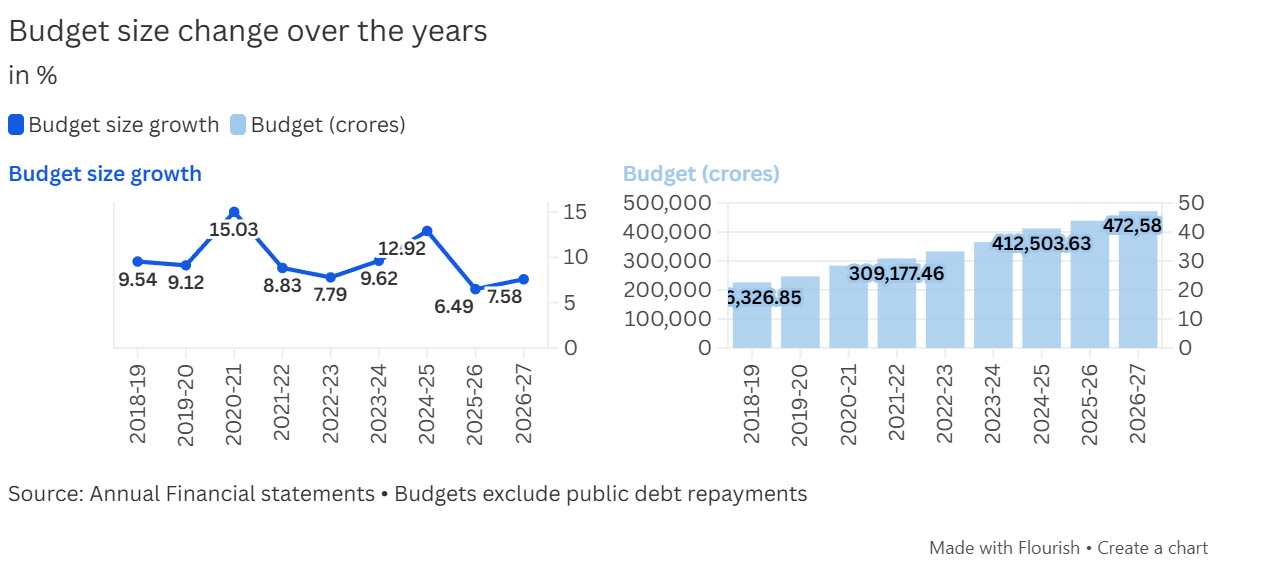
- Tamil Nadu’s total receipts are estimated at ₹3,50,766 crore, while total expenditure is projected at ₹4,72,585 crore, resulting in a revenue deficit of ₹55,775 crore.
- The government’s expenditure is 7.6% over the 2025-26 budget.
- The State’s Own Tax Revenue (SOTR) is projected to grow by 9.78%, with Commercial Taxes contributing 68.9% of the collections, followed by Stamps and Registration (15.5%) and State Excise (6.2%).
- It said the State’s outstanding debt is estimated at ₹10.98 lakh crore in the Revised Budget Estimates (RBE) for 2026-27.
- It was against ₹10,99,458 crore in the Interim Budget Estimates (IBE) 2026-27.
- The outstanding debt-to-GSDP ratio is estimated at 27.01%, and the government plans to borrow ₹1,73,445 crore and repay ₹51,971 crore during the current financial year.
- It was 27.03% in the IBE 2026-27.
- The outstanding debt includes Public Debt and the Public Account Liability of the State.
Fiscal Deficit
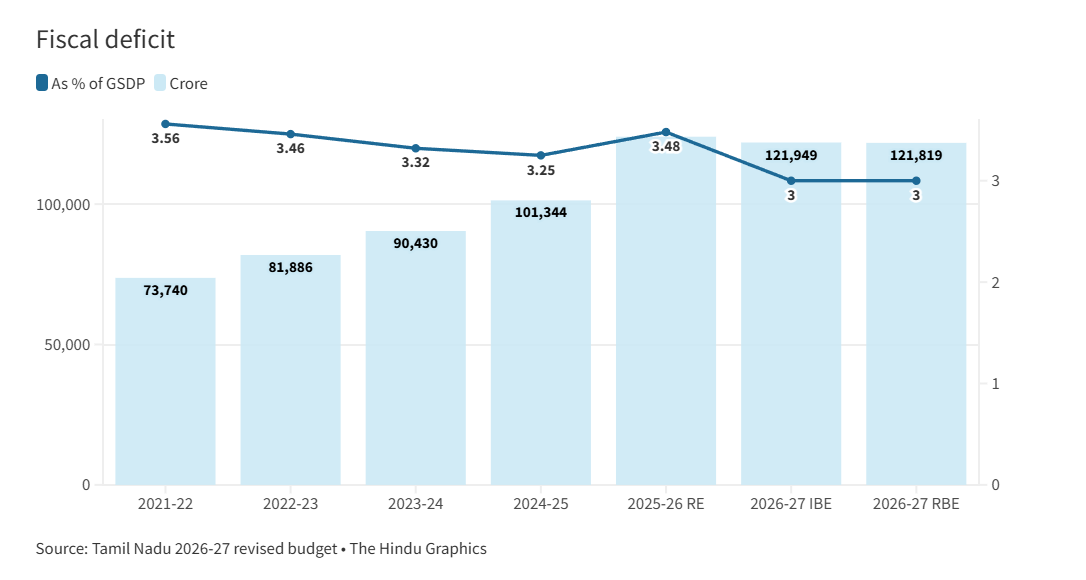
- Fiscal deficit was 3% of GSDP, unchanged from the interim budget’s figure.
- The fiscal deficit has been decreasing (as a % of GSDP) since 2021-22, except for an increase in 2025-26.
- The Fiscal Deficit in the RBE 2026-27 is estimated at ₹1,21,819 crore as against ₹1,21,949 crore in the IBE 2026-27.
- The Fiscal Deficit is within the targets fixed under the Tamil Nadu Fiscal Responsibility Act, 2003.
- Fiscal deficit is an indicator of the government’s overall borrowing requirements.
Revenue Deficit
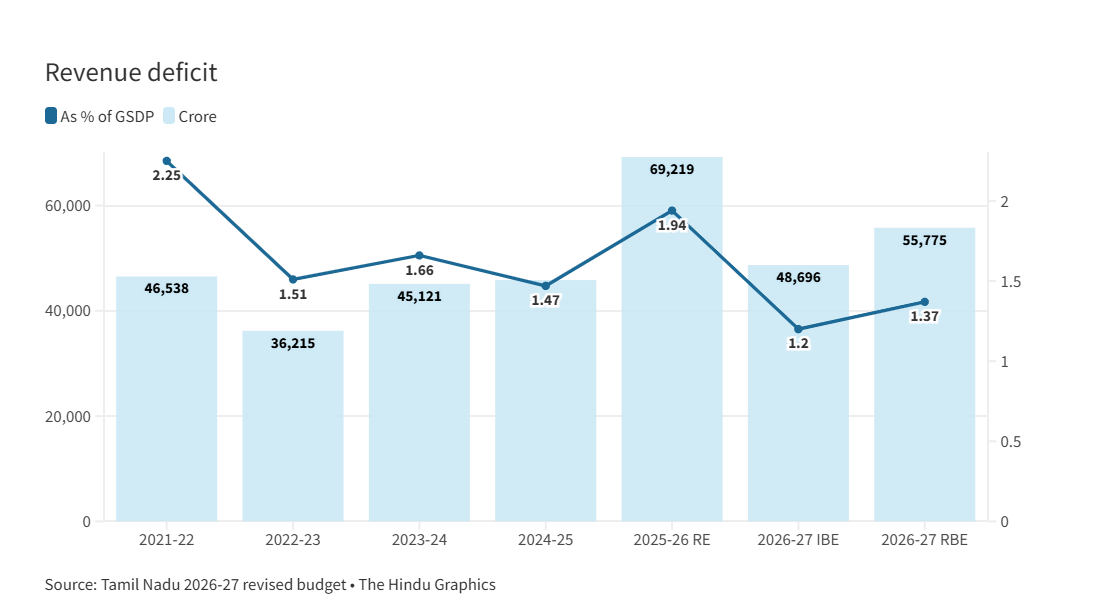
- The revenue deficit in the budget was pegged at 1.37% of Gross State Domestic Product (GSDP), an increase from 1.2% in the interim budget tabled by the previous government before the elections, but lower than that in the 2025-26 budget.
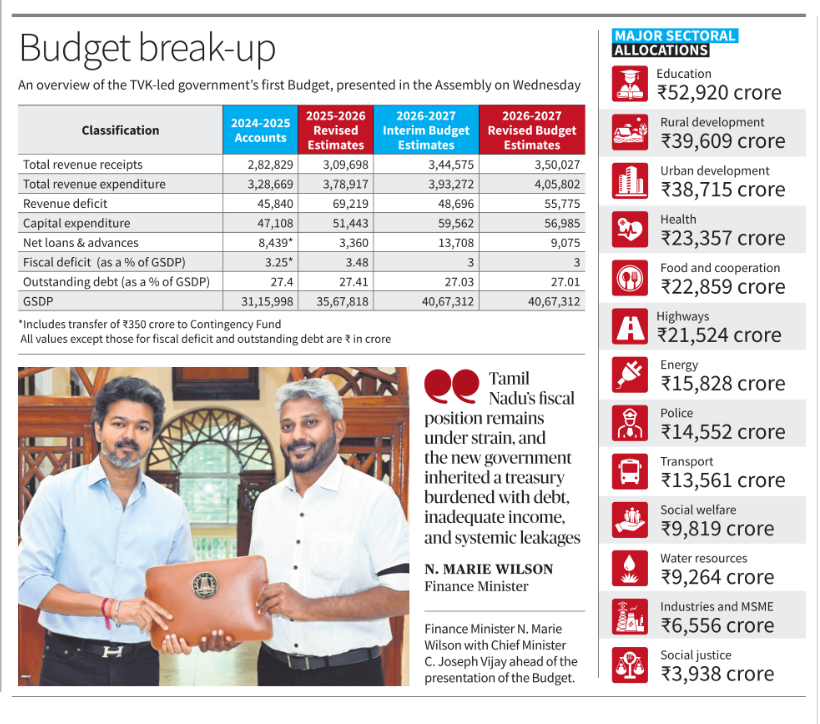
- In terms of value, the deficit stood at ₹55,775 crore as per the RBE 2026-27.
- The Revenue Deficit in the IBE 2026-27 was ₹48,696 crore.
Total Revenue receipts
- The Tamil Nadu government’s expectation of more funds from the Union government has revised upwards the estimated amount of total revenue receipts (TRR) for the current year.
- In the past three out of five years, the budget estimates for the TRR were pushed down at the time of arriving at the revised estimates.
- On the contrary, this time, the TRR figure is higher by ₹5,452 crore over the budget estimate’s figure.
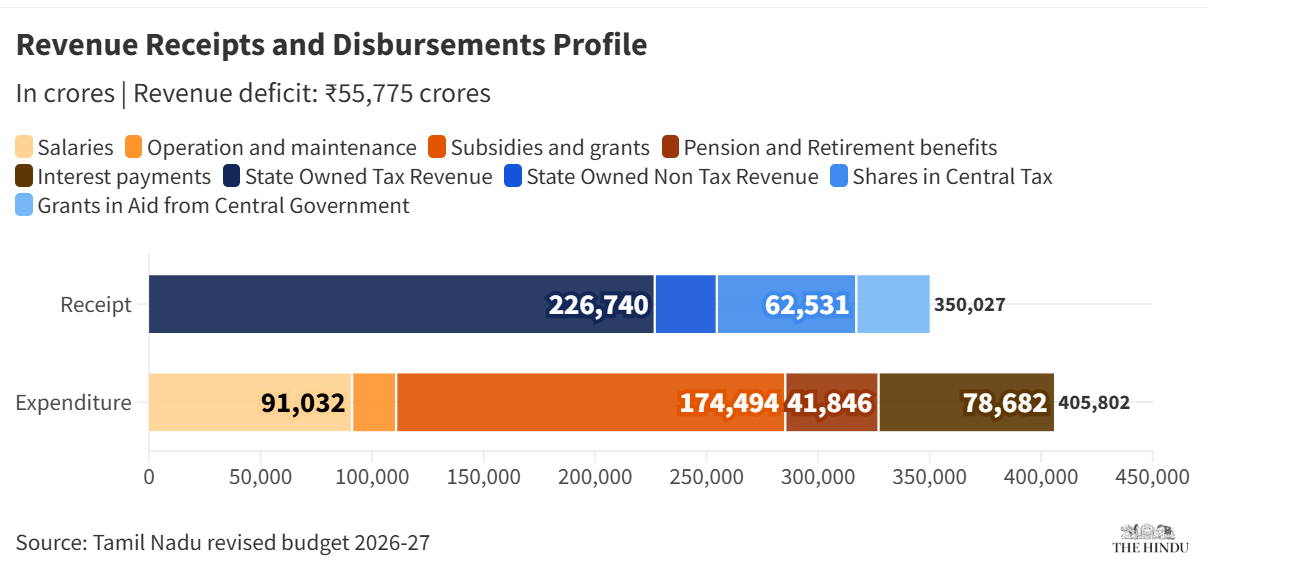
- Compared to ₹3,44,575 crore provided at the time of the presentation of the budget figure earlier this year, the State government has calculated that the TRR will be ₹3,50,027 crore.
- The Total Revenue Receipts of the State Government include the Grants in Aid and Transfers from Union Government.
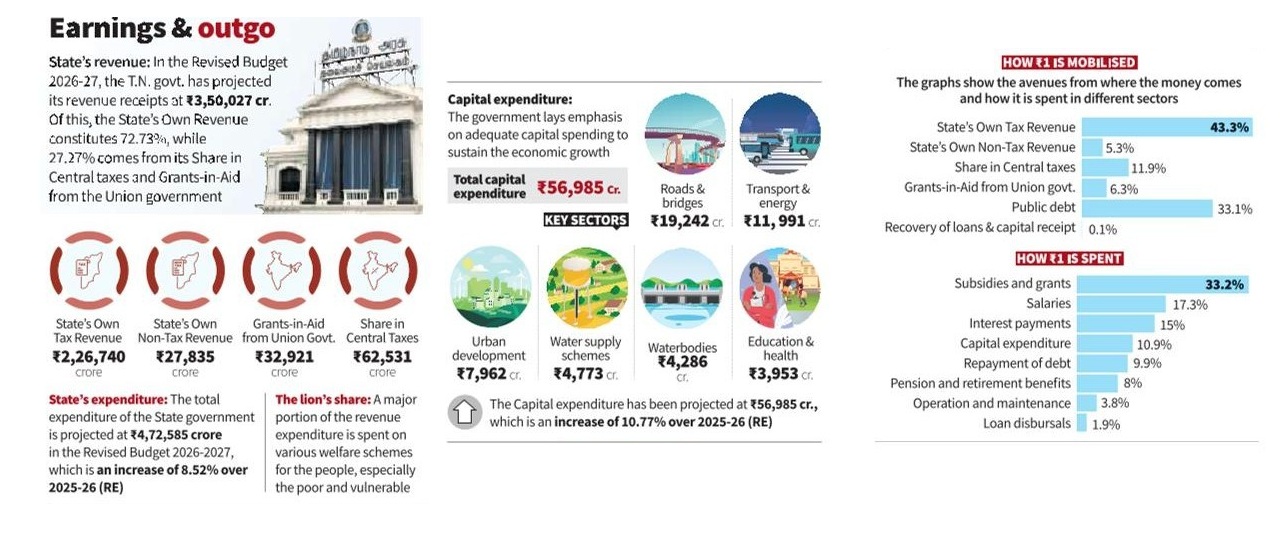
- The Grants-in-aid from the Union Government is estimated at Rs.32,922 crore in Revised Budget Estimates 2026-27.
- The centre’s contribution in the form of grants-in-aid and taxes made up around 18%.
- Tamil Nadu’s share in Central Taxes is estimated at Rs.62,531 crore in Revised Budget Estimates 2026-27 as estimated in the Interim Budget Estimates.
- This is based on the estimates in the Union Budget 2026-27.
Tax Revenues
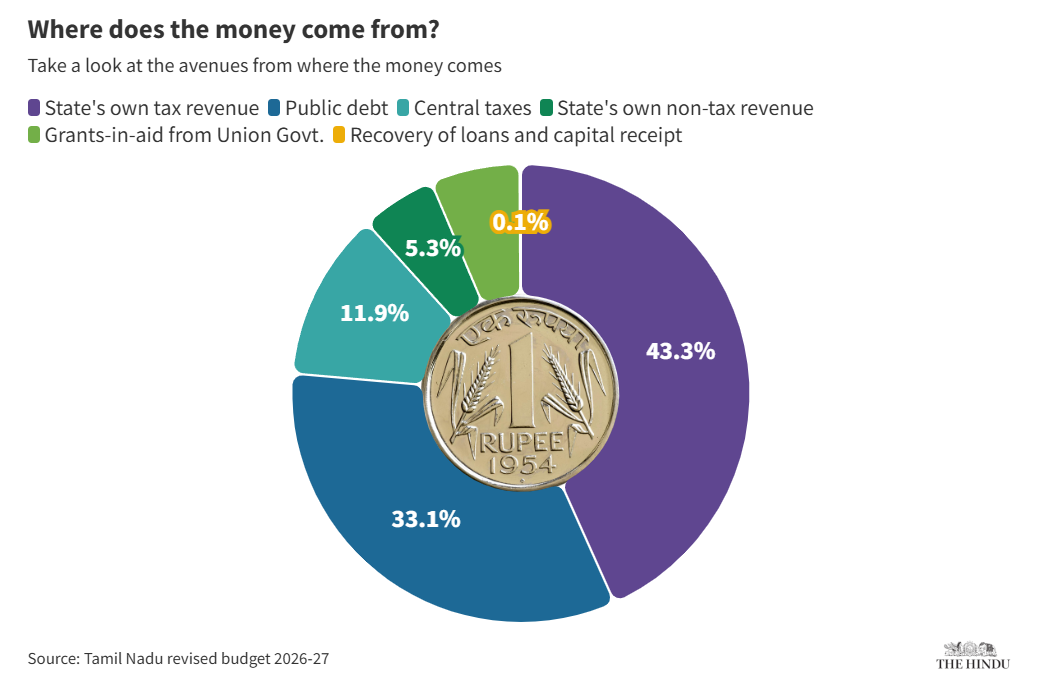
- The government’s sources for money are primarily driven by its own tax revenue, which makes up 43% of the money that the government has to spend.
- In the Revised Budget Estimates 2026-27, State’s Own Tax Revenue is estimated at ₹2,26,740 crore, compared to the Interim Budget Estimates 2026-27 projection of ₹2,29,579 crore.
- This allocation includes Rs.1,56,176 crore for Commercial Taxes, Rs.35,109 crore for Stamps and Registration, Rs.14,861 crore for Motor Vehicle Taxes, and Rs.14,164 crore for State Excise.
- The State’s Own Tax Revenue (SOTR) is projected to grow by 9.78%, with Commercial Taxes contributing 68.9% of the collections, followed by Stamps and Registration (15.5%) and State Excise (6.2%).
- The VAT (Value Added Tax) and Excise collections (from alcohol) is expected to rise to ₹55,962 crore in 2026-27 from ₹51,000 crore last year.
- The State’s Own Non-Tax Revenue is estimated at ₹27,704 crore in the IBE, as compared to ₹26,265 crore in the RE 2025-26.
- In the RBE 2026-27, State Own Non-Tax Revenue is estimated at ₹27,835 crore.
- Non-tax revenue made up 33.1%.
VB G RAM G Act
- The Union Government has introduced a new scheme, ‘Viksit Bharat-Guarantee for Rozgar and Ajeevika Mission (Gramin) in place of the Mahatma Gandhi National Rural Employment Guarantee Scheme.
- An amount of Rs.7,586 crore has been provided under this scheme with a 60:40 sharing pattern.
- The increase in funds will be an outcome of the State government’s participation in the Viksit Bharat-Guarantee for Rozgar and Ajeevika Mission (Gramin) (VB G RAM-G), according to a perusal of the revised budget documents for 2026-27.
- This is being reflected in the Centrally Sponsored Schemes (CSS), which will see a rise of about ₹9,790 crore.
- Furthermore, a sum of Rs.3,461 crore that is due to be released to Tamil Nadu under the Mahatma Gandhi National Rural Employment Guarantee Scheme has also been included in the Revised Budget Estimates for the year 2026-27.
Revenue Expenditure
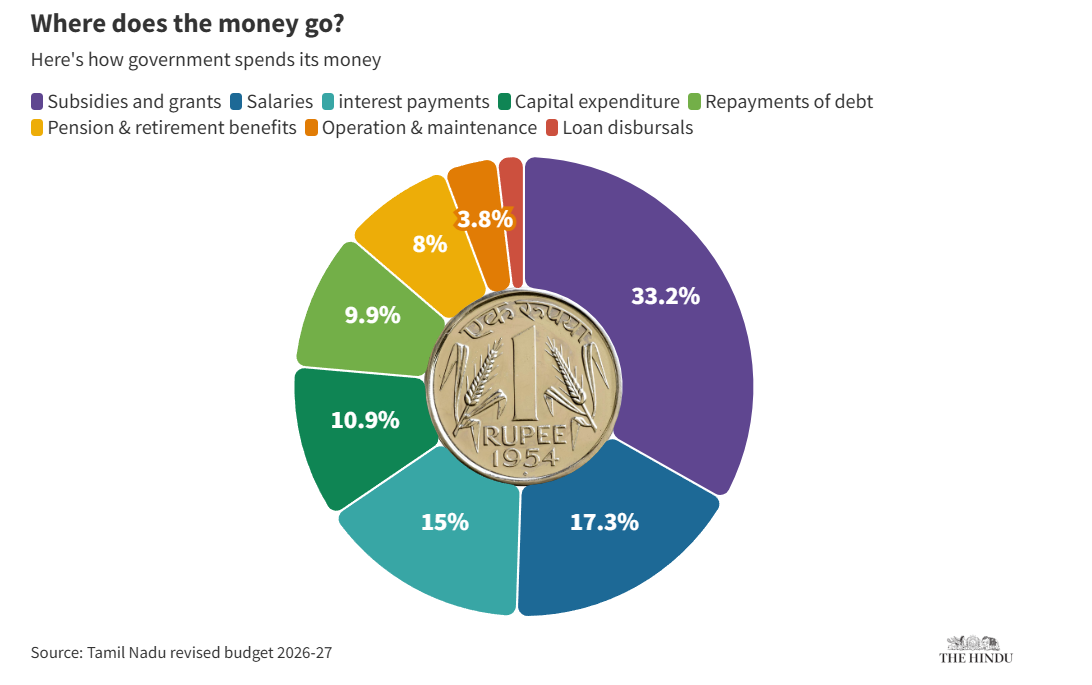
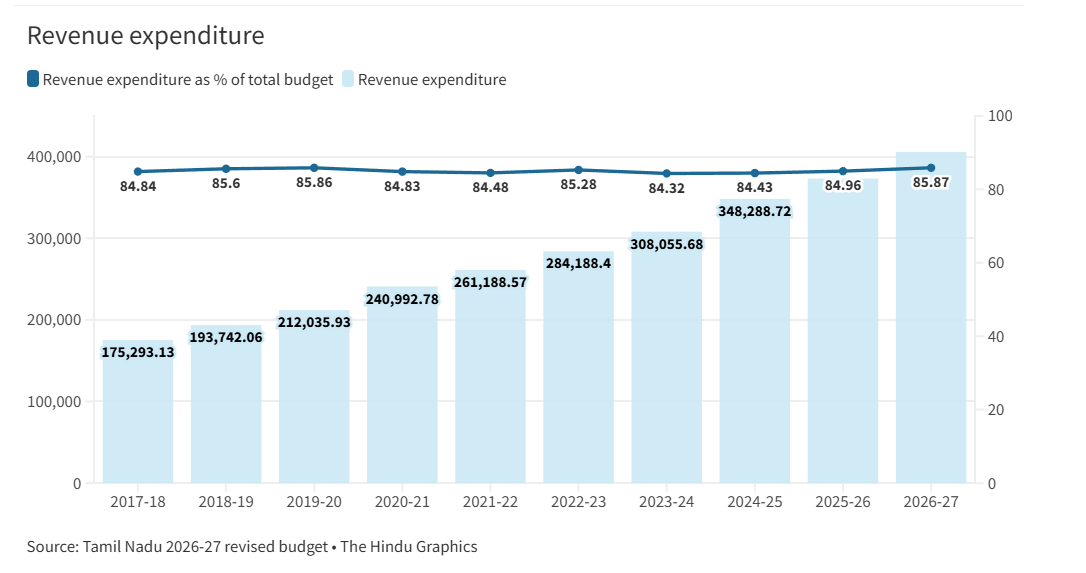
- When it comes to avenues of expenditure, subsidies and grants made up 33.2% of expense.
- Repayment of debt was 9% of the government’s expenditure.
- On the expenditure front, Total Revenue Expenditure has been revised upward to ₹4,05,802 crore in the RBE 2026-27 from ₹3,93,272 crore in the IBE 2026-27.
- This increase is attributable to mandatory outlays for new flagship commitments, agricultural crop loan waivers, 200 units of free electricity, and the Thai Maaman Thanga Mothiram scheme.
- The expenditure on account of Salaries is a committed expenditure.
- In the Revised Budget Estimates 2026-27, Salaries has been fixed at Rs.91,032 crore as compared to Rs.94,378 crore in the Interim Budget Estimates 2026-2027.
- The expenditure on account of committed expenditure on Pensions and Retirement benefits is estimated to be Rs.41,846 crore in the Revised Budget Estimates 2026-27.
- The expenditure on account of Subsidies and Transfers is estimated to be Rs.1,74,494 crore in the Revised Budget Estimates 2026-27.
- The interest payments for public debt raised in the previous years are a committed liability of the Government and continue to increase every year.
- The expenditure on account of interest payments is estimated at Rs.78,683 crore in the Revised Budget Estimates 2026-27.
Capital Expenditure
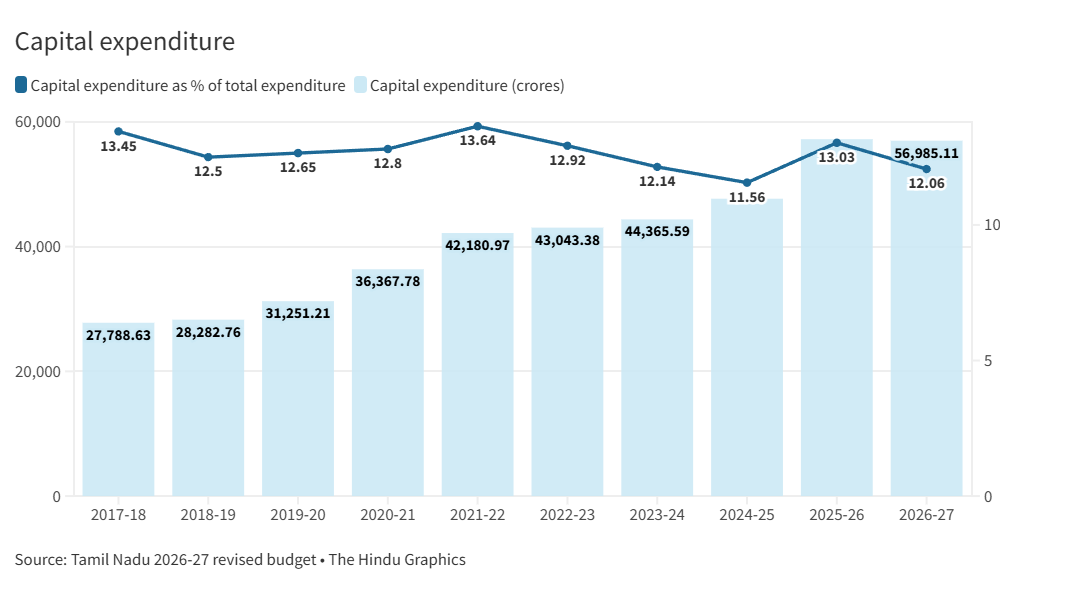
- Capital expenditure in the budget was pegged at ₹56,985 crores, or 12.06% of the budget’s total expenditure.
- It is estimated at ₹56,985 crore in the RBE 2026-27.
- Important sectors receiving capital expenditure include roads and bridges (₹19,242 crores), transport and energy (₹11,991 crores), urban development (₹7,692 crores), water supply schemes (₹4,773 crores), waterbodies (₹4,286 crores), education & health (₹3,953 crores).
- The total capital outlay of the State, including Net Loans and Advances, is estimated at ₹66,060 crore in the RBE 2026-27.
Allocations
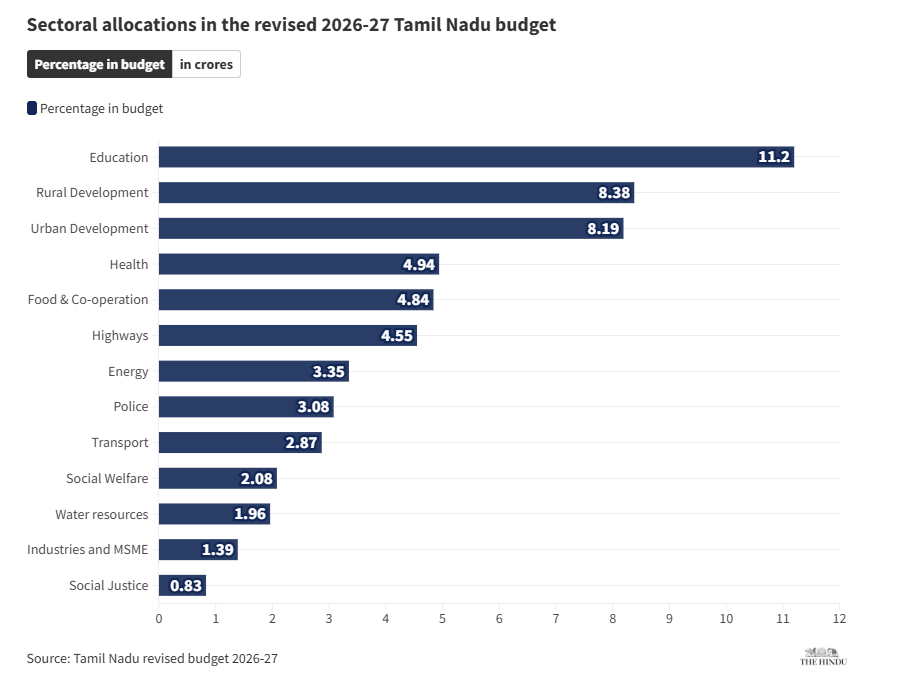
- A total of ₹44,527 crore has been allocated for the School Education Department.
- When it comes to major sectoral allocations, the education sector was allocated 11.2% of the budget, with rural development and urban development receiving 8.4% and 8.2% respectively.
- The education sector was followed by Rural Development (₹39,609 crore), Urban Development (₹38,715 crore), Health (₹23,357 crore), and Food and Cooperation (₹22,859 crore).
- The total outlay for the higher education department has been put at ₹8,393 crore.
Final
- The outstanding guarantees for each year have to be restricted at a level of 100 per cent of the Total Revenue Receipts in the preceding year or 10 per cent of the GSDP, whichever is lower.
- The outstanding guarantees as on 31st March, 2026 were 63.57 per cent of Total Revenue Receipts in the preceding year and 5.04 per cent of GSDP.
- The outstanding risk weighted guarantees for each year have to be kept at a level of 75 per cent of the Total Revenue Receipts of the preceding year or 7.5 per cent of GSDP, whichever is lower.
- The outstanding risk weighted guarantees as on 31st March, 2026 stood at 23.46 per cent of Total Revenue Receipts of the preceding year and 1.86 per cent of GSDP.

Leave a Reply
Your Comment is awaiting moderation.