

PREVIOUS
✖
Tamil Nadu Development Model
February 28 , 2026
162 days
8522
0
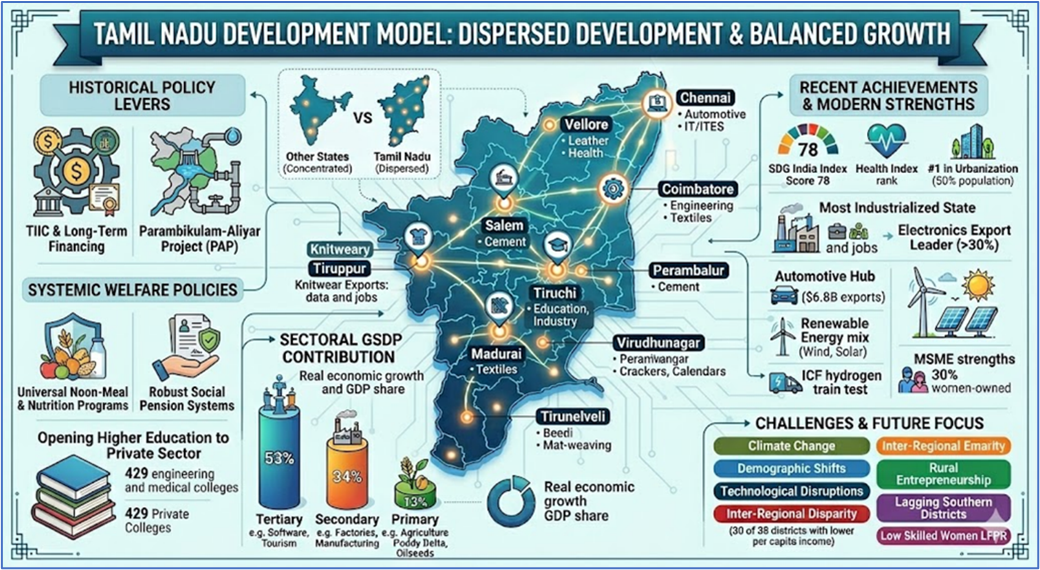
- Unlike in other States such as Maharashtra and Karnataka, where economic activity is concentrated in a couple of cities, Tamil Nadu has been witnessing dispersed development.
- Besides Chennai, the State has other urban centres — Coimbatore, Madurai, Tiruppur, Tiruchi, Vellore, and Salem — contributing significantly to its economy and helping bridge the urban-rural divide.
- The spread of activity can be seen from the location of a host of spinning mills in the western district of Tiruppur.
- It accounted for 55% of the country’s knitwear exports to the tune of ₹30,690 crore in 2023-24, providing jobs to six lakh persons.
- Calendar- and cracker-making units in the southern district of Virudhunagar, cement production in the central district of Perambalur, and beedi-making and mat-weaving in Tirunelveli are also a testament to this fact.
- Tamil Nadu is the most urbanized State in the country, with close to 50% of the population living in urban areas, according to the 2011 Census.
- The State not only had the first-mover advantage during the ‘License Raj’ in creating a solid base in manufacturing, but also did not lag behind others in taking to information technology (IT) and IT-enabled services (ITES) in the post-1990 ‘economic reforms’ era.
- In the Sustainable Development Goals (SDG) India Index 2023-24 published by the NITI Aayog in 2024, Tamil Nadu emerged as a frontrunner, reflecting the State’s dedicated efforts and comprehensive policies on sustainable development.
- The composite score for Tamil Nadu rose to 78 in the edition in question — a remarkable rise from 66 in 2018.
- The State ranks second in low infant mortality and low birth rate, and third in the Health Index.
- It is known for its innovative welfare schemes such as the noon-meal scheme — twice revived in 1956 and 1982.
- The old-age pension scheme was introduced in April 1962 in this state with improvements made over the previous versions.
- Within two years of freedom, it set up the Tamil Nadu Industrial Investment Corporation (TIIC) to handle long-term financing.
- The TIIC’s presence came in handy during the period of K. Kamaraj, who was Chief Minister of the State from 1954 to 1963.
- He enabled the Corporation to participate in the share capital of private enterprises.
- The State, in the mid-1980s, opened up higher education to the private sector, facilitating the formation of a number of engineering and medical colleges.
- As of now, there are 22 self-financing private medical colleges, four private universities, and 13 colleges affiliated with deemed-to-be universities.
- In engineering and architecture, there are 429 self-financing colleges, apart from 11 government colleges.
- Accounting for 4% of India’s land area and 6% of the country’s population, Tamil Nadu contributed 9.21% to the national GDP in 2024-25, ranking second only to Maharashtra.
- Its Gross State Domestic Product (GSDP) at constant prices (2011-12 series) reached about ₹17.23 lakh crore, reflecting the real economic growth of 11.19% over the previous year.
- In fact, the State was the only one to register a double-digit growth rate in the year in question, besides having the growth rate in double digits after a gap of 14 years.
- Broadly, the respective shares of the primary (agriculture and allied activities), secondary (industry), and tertiary (services) sectors in the GSDP of the State are 13%, 34%, and 53%.
- At the time of Independence, Tamil Nadu’s economy was essentially agrarian.
- The Supreme Court judgment of February 2018 on the Cauvery dispute states that prior to 1924.
- In 1924, the inter-State agreement was signed between Tamil Nadu, the lower riparian State, and Karnataka, the upper riparian State.
- The area under irrigation in the former (Tamilnadu) was about 15 lakh acres, whereas the latter’s coverage (Karnataka) was hardly one-third of that.
- The delta region is regarded as the rice bowl of the South.
- It accounts for about one-third of paddy cultivation in the State.
- It accounts 18 lakh acres out of a total of 52 lakh acres.
- Needless to say, paddy has been the primary crop of the farmers in Tamil Nadu.
- It was during the immediate post-Independence period that Tamil Nadu found that there were not many irrigation schemes for the drought-prone areas in the western belt — Coimbatore, Tiruppur, and Erode districts.
- This led to the birth of the Parambikulam-Aliyar Project (PAP) after an inter-State understanding with Kerala in 1958 over the diversion of west-flowing rivers to irrigate the western region of Tamil Nadu.
- C. Subramaniam was a towering figure of the Congress, who hailed from the region.
- He played a key role in getting the project off the ground.
- He occupied high positions both in the State government — Finance Minister (1952-62) — and at the Centre — Minister for Steel, Food and Agriculture, Planning and Finance (1962-67 and 1971-77).
- Now hailed as a symbol of inter-State cooperation, the PAP irrigates about 4.2 lakh acres.
- Still, Tamil Nadu is regarded as one of the major States with productivity higher than the all-India average in oilseeds, groundnut, sugarcane, maize, and paddy.
- It is according to the Agricultural Statistics at a Glance (2023) published by the Department of Agriculture and Farmers Welfare of the Union government.
- Even though the State does not produce cotton in large quantities, it is home to the largest number of spinning mills.
- In 1950s Madras was regarded as a benighted agricultural province, with little power, capital and infrastructure.
- The provincial administration also lacked enterprise.
- It refused to buy up the Madras Tramways which was closing down [in April 1953] for a sum as low as Rs. 19 lakhs.
- Today, the Tamil Nadu Small Industries Development Corporation Limited (TANSIDCO) maintains 135 Industrial Estates spread over nearly 8,880 acres.
- MSMEs have registered themselves with the Udyam portal of the Union MSME Ministry
- As for the strength of MSMEs, there are about 33.6 lakh — around 70% of them being in services.
- As an indication of Tamil Nadu’s model of inclusive growth, 30% of MSM entrepreneurs are women.
- As of March 31, 2022, Other Backward Classes (OBCs) in the State owned around 3.37 lakh MSMEs, accounting for approximately 40%, and Scheduled Castes (SCs) owned 50,908 units, or about 6%.
- Tamil Nadu has become the country’s most industrialized State with the highest number of factories (39,700), employing 2.8 million people.
- It is the foremost exporter of electronic goods, accounting for over 30% of India’s electronic exports.
- In terms of total exports from the State, the value was around $52 billion in 2024-25.
- The country’s first hydrogen-powered train coach was tested in July 2025 in the Integral Coach Factory (ICF) in Chennai.
- The Neyveli Lignite Corporation has power units of about 3,400 megawatts (MW) in Neyveli.
- The State’s total installed electricity capacity from all sources of energy stood at close to 40 GW in 2024-25.
- Of which the conventional sources accounted for 16.7 GW and renewable energy, 23 GW.
- Again, a pioneer in tapping wind energy, the State’s installed wind capacity was 9.3 GW, and solar 10 GW.
- Tamil Nadu Power Distribution Corporation has about 30.44 million consumers.
- Like other States, the service sector plays a pivotal role in driving Tamil Nadu’s Gross State Value Added (GSVA).
- In 2024-25, the services accounted for ₹8.13 lakh crore at constant prices (base year: 2011-12), contributing about 53% to Tamil Nadu’s total GSVA.
- Placed next to Karnataka, Maharashtra, and Telangana in software exports, the State saw a steady increase in this segment of exports from ₹46,704 crore in 2019-20 to ₹73,969 crore in 2022-23.
- It was according to the Tamil Nadu government’s Economic Survey for 2024-25.
- The degree of heightened economic activity in the State can be observed from the credit-deposit ratio (CDR) with credit exceeding deposits.
- The Survey points out that in 2023-24, Tamil Nadu disbursed credits of ₹15,82,851 crore, whereas it received deposits of ₹13,44,553 crore.
- Naturally, it is among the top three States with regard to the CDR.
- As regards the road sector, the total length of roads in the State is 74,955 km, including the National Highways’ share of 6,805 km.
- It is a tribute to the political, administrative, and social environment of Tamil Nadu that there are about 130 global Fortune 500 companies in the State.
- Nearly one-third ($6.8 billion) of the country’s exports in automotive and auto components comes from the State.
- The State also produces 25% of the country’s passenger cars and 36% of two-wheelers.
- However, the State is facing a number of challenges in all three broad sectors of the economy.
- The Economic Survey captures some of these challenges — namely, climate change, demographic shifts, technological disruptions, and changing employment landscapes.
- Inter-regional disparity is particularly glaring.
- Although the State’s overall per capita income of ₹2.78 lakh (2022-23) is higher than the national average of ₹1.69 lakh, 30 of the 38 districts in the State have a lower per capita income than the State’s average.
- Tamil Nadu also needs to concentrate on developing rural entrepreneurship to spread growth across all the districts of the State.
- The State’s long coastline was extending for 1,076 km, and the extent of effective inland water resources are over 3.85 lakh ha.
- In the dairy sector, there is enormous scope for improvement, as the State is placed 11th at the all-India level in milk production.
- Southern districts, which represent 18.8% of the economy and 20.5% of the population in the State, have been lagging behind others.
- The Survey points out that “despite having one of the highest Labour Force Participation Rates (LFPR) for women in India, there is still considerable scope to increase this rate.
- The gross enrolment rate for women in tertiary education is one of the highest in the country, but the participation of such skilled women is relatively low.

Leave a Reply
Your Comment is awaiting moderation.