

PREVIOUS
✖
10-Billion-Year-Old Radio Signal
May 28 , 2026
14 hrs 0 min
46
0
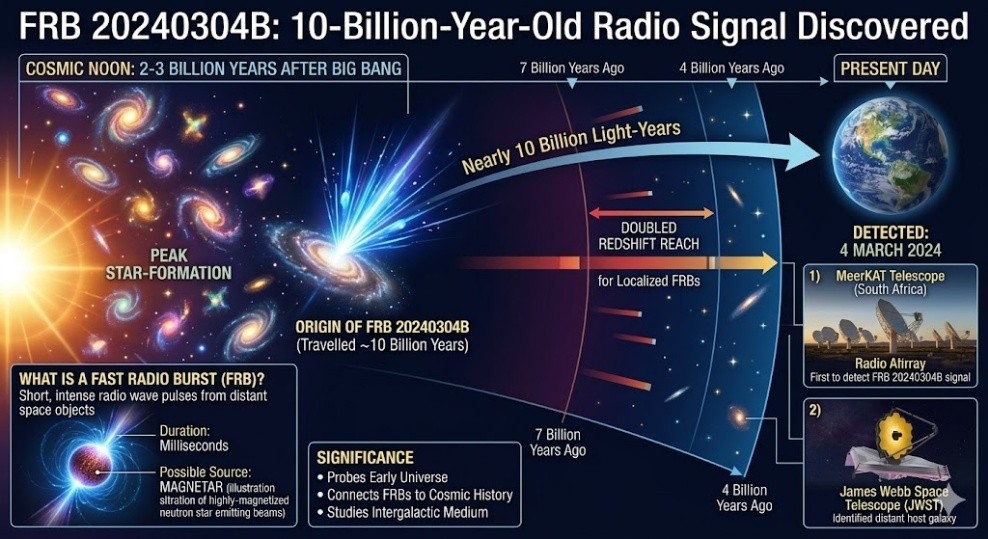
- Scientists detected FRB 20240304B, a fast radio burst that travelled nearly 10 billion years before reaching Earth.
- The signal was detected by the MeerKAT telescope in South Africa on 4 March 2024, and its host galaxy was identified using the James Webb Space Telescope.
- Fast Radio Bursts (FRBs) are short and intense radio wave pulses from distant space objects, and magnetars are considered one possible source.
- The burst originated during “Cosmic Noon”, the peak star-formation period that occurred about 2–3 billion years after the Big Bang, and it doubled the redshift reach of localised FRBs.
- LOFAR (Low Frequency Array), a European radio telescope network, also detected a radio mini-halo around the SpARCS1049 galaxy cluster, located about 10 billion light-years away.

Leave a Reply
Your Comment is awaiting moderation.