

PREVIOUS
✖
16th Finance Commission report
February 5 , 2026
17 hrs 0 min
44
0
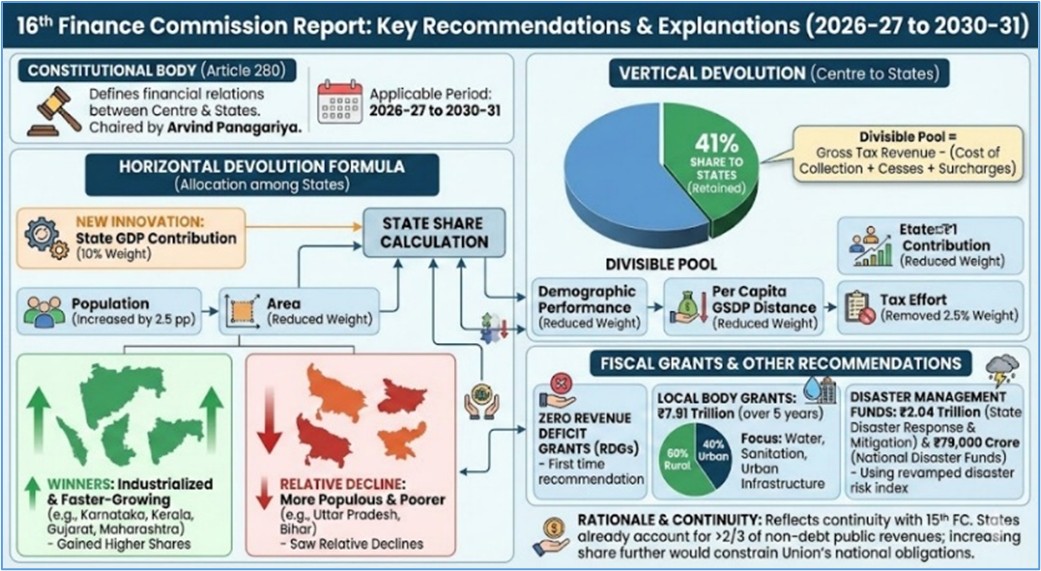
- The 16th Commission was chaired by Arvind Panagariya.
- The Finance Commission is a constitutional body (Article 280) that defines the financial relations between the Centre and the States.
- The 16th Finance Commission retained 41% tax devolution from the divisible pool to states.
- The divisible pool consists of gross tax revenue excluding the cost of collection, cesses, and surcharges
- Its recommendations will apply from 2026-27 to 2030-31.
- A major innovation is the introduction of State GDP contribution as a new parameter in the horizontal devolution formula, with a 10% weight.
- It argued that states already account for over two-thirds of total non-debt public revenues, and increasing their share further would constrain the Union government’s ability to meet national obligations.
- This decision reflects continuity with the 15th Finance Commission
- It removed the 2.5% weight for tax effort, increased the population weight by 2.5 percentage points.
- And it reduced the weights for area, demographic performance, and per capita GSDP distance.
- As a result, industrialized and faster-growing states like Karnataka, Kerala, Gujarat and Maharashtra gained higher shares, while more populous and poorer states such as Uttar Pradesh and Bihar saw relative declines.
- For the first time, the Commission recommended zero Revenue Deficit Grants (RDGs).
- While cutting RDGs, the Commission earmarked ₹7.91 trillion for rural and urban local bodies over five years, with a 60:40 rural–urban split, focusing on water, sanitation and urban infrastructure.
- It also recommended ₹2.04 trillion for State Disaster Response and Mitigation Funds and ₹79,000 crore for national disaster funds, using a revamped disaster risk index.

Leave a Reply
Your Comment is awaiting moderation.