

PREVIOUS
✖
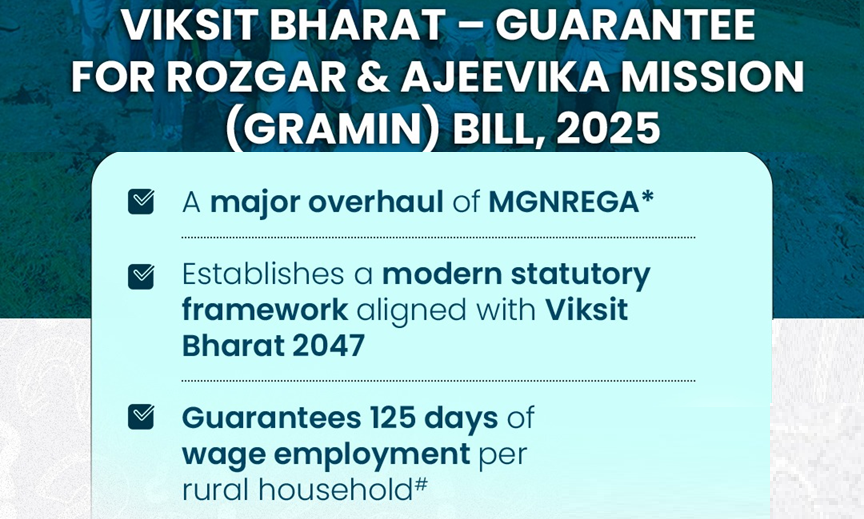
Ajeevika Mission (Gramin) Bill, 2025
December 20 , 2025
14 hrs 0 min
104
0
- The Bill replaces the Mahatma Gandhi National Rural Employment Guarantee Act, 2005 (MGNREGA), which had been in force for about twenty years.
- It was introduced by the Union Agriculture Minister to create a modern law aligned with the Viksit Bharat 2047 vision.
- Guaranteed wage employment is increased from 100 days to 125 days per rural household for adults doing unskilled manual work.
- Under MGNREGA, the law guaranteed not less than 100 days, and extra days were allowed only during droughts or for some tribal areas.
- The Bill introduces a 60-day agricultural pause during peak sowing and harvesting seasons.
- The purpose of the agricultural pause is to ensure availability of labour for farming activities.
- Under MGNREGA, the Central Government paid 100 percent of unskilled wages and 75 percent of material costs, resulting in a 90:10 Centre - State funding pattern.
- The new scheme works as a Centrally Sponsored Scheme (CSS) with 90:10 funding for North-Eastern and Himalayan States, 60:40 for other States, and 100 percent Central funding for Union Territories without legislatures.
- MGNREGA was demand-based, universal, and allowed the budget to increase based on need.
- The new Bill allows the Union Government to notify specific rural areas in a State for implementation.
- The Bill mandates the creation of the Viksit Bharat National Rural Infrastructure Stack.
- All works under the scheme will be brought together under this single national infrastructure framework.
- The framework integrates Viksit Gram Panchayat Plans with the Pradhan Mantri (PM) Gati Shakti National Master Plan.
- Works are grouped into four areas: water security, core rural infrastructure, livelihood-related infrastructure, and disaster mitigation.
- The Bill makes biometric attendance compulsory for workers.
- It also mandates Artificial Intelligence (AI) based fraud detection, Global Positioning System (GPS) tracking of worksites, and weekly public disclosure of scheme data by law.

Leave a Reply
Your Comment is awaiting moderation.