

PREVIOUS
✖
Amazon Forest Fires at Historic Low
July 28 , 2026
9 hrs 0 min
6
0
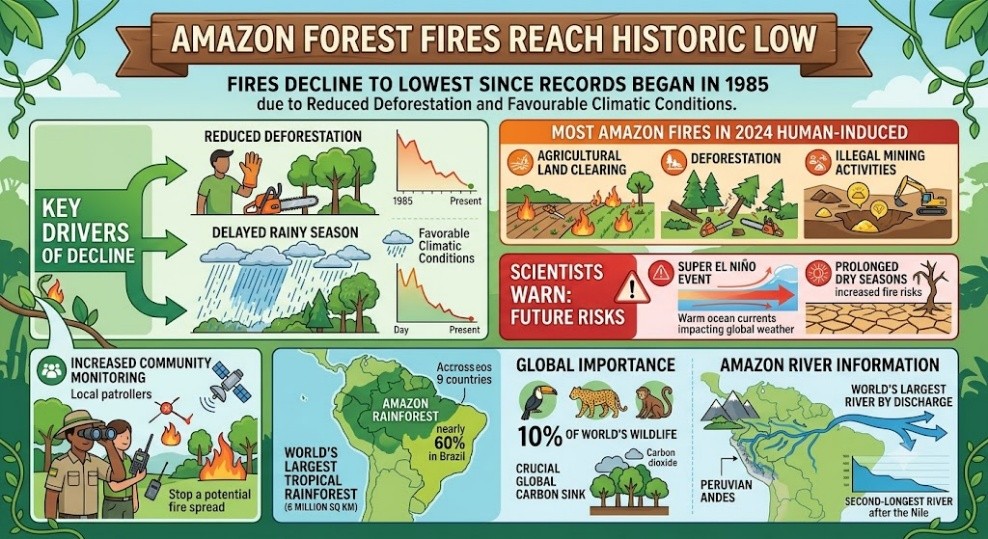
- Forest fires in Brazil’s Amazon rainforest have declined to their lowest level since records began in 1985 due to reduced deforestation and favourable climatic conditions.
- The decline in fires was supported by a delayed rainy season, reduced deforestation, and increased community monitoring that limited fire spread.
- Most Amazon fires in 2024 were human-induced, mainly caused by agricultural land clearing, deforestation, and illegal mining activities.
- Scientists warned that a possible Super El Niño event may increase future fire risks by causing prolonged dry seasons.
- The Amazon Rainforest is the world’s largest tropical rainforest, covering about 6 million sq. km across nine South American countries, with nearly 60% in Brazil.
- The Amazon Basin is a major biodiversity hotspot, containing around 10% of the world’s known wildlife species and acting as an important global carbon sink.
- The Amazon River, originating in the Peruvian Andes, is the world’s largest river by discharge and the second-longest river after the Nile.

Leave a Reply
Your Comment is awaiting moderation.