

PREVIOUS
✖
Article 142 - Limits and Powers
September 7 , 2026
15 hrs 0 min
24
0
- The Supreme Court used Article 142 of the Constitution to quash criminal cases registered against NEET (National Eligibility cum Entrance Test) protesters.
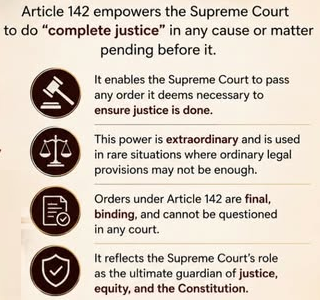
- Article 142 empowers the Supreme Court to pass orders necessary to “do complete justice” in any case before it, and such orders are enforceable throughout India.
- The power is very wide, but it cannot be used to pass an order that violates the Constitution or fundamental rights.
- The Supreme Court has held that Article 142 can supplement existing law, but normally cannot replace substantive law or affect the rights of people who are not parties to the case.
- In Shilpa Sailesh v. Varun Sreenivasan (2023), the Court held that Article 142 can allow departure from procedural or substantive law when necessary to achieve complete justice, subject to public policy.
- In High Court Bar Association, Allahabad v. State of Uttar Pradesh (2024), the Court reiterated that Article 142 cannot violate natural justice, including the right to be heard.

Leave a Reply
Your Comment is awaiting moderation.