

PREVIOUS
✖
Bangladesh General Elections 2026
February 17 , 2026
19 hrs 0 min
8
0
- Bangladesh held its 13th parliamentary election in February 2026, the first national election after the 2024 mass uprising that removed Sheikh Hasina’s government.
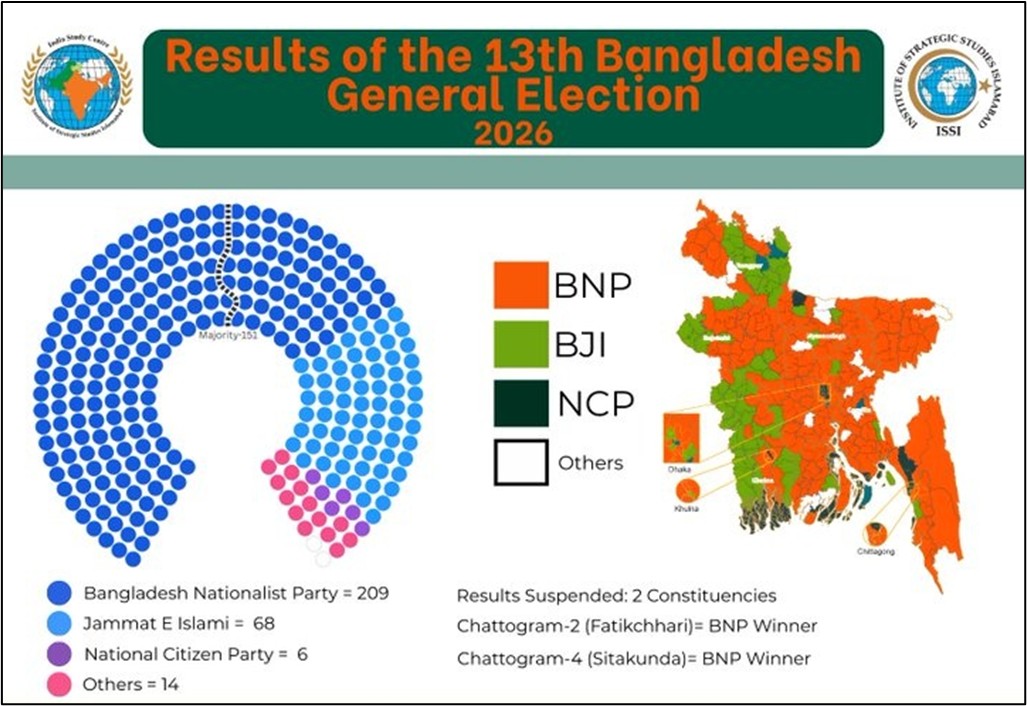
- The Bangladesh Nationalist Party (BNP) won a landslide victory, securing a strong majority in Parliament.
- Tarique Rahman, chairman of the BNP and son of former Prime Minister Khaleda Zia, is set to become Prime Minister after the election victory.
- Rahman will become the first male Prime Minister of Bangladesh in decades, following his mother Khaleda Zia, the country’s first female PM
- She died in December 2025.
- His father, Gen Ziaur Rahman, took power in 1975 and became Bangladesh’s President, before he was assassinated in 1981.
- The country had been governed by an interim administration led by Nobel laureate Muhammad Yunus since the political crisis of 2024.
- In July 2025, Bangladesh approved a constitutional referendum known as the “July Charter.”
- The referendum proposed major constitutional reforms to replace the 1972 Constitution framework.
- The Charter was drafted by the interim government’s National Consensus Commission, drawing on recommendations from six reform commissions focused on the constitution, judiciary, electoral system, police, public administration and anti-corruption.
- Key charter reforms include increasing women’s political representation, imposing prime ministerial term limits, enhancing presidential powers, expanding fundamental rights, and protecting judicial independence.
- The referendum will give people a chance to vote on reforms to state institutions.
- A referendum in direct democracy is a voting process where citizens directly accept or reject specific laws, constitutional amendments, or policies, rather than leaving decisions solely to elected representatives.
Leave a Reply
Your Comment is awaiting moderation.