

PREVIOUS
✖
Constitution (131st Amendment) Bill, 2026
April 18 , 2026
15 hrs 0 min
33
0
- The Constitution (131st Amendment) Bill, 2026, was introduced in the Lok Sabha on April 16, 2026, after a division vote with 251 Members of Parliament supporting and 185 opposing.
- It was introduced by Union Law Minister Arjun Meghwal along with the Delimitation Bill, 2026 and the Union Territories Laws (Amendment) Bill, 2026 as a linked package, where the latter two depend on this amendment.
- The Bill proposes to amend Articles 81, 82, 170, 332 and 334A of the Constitution.
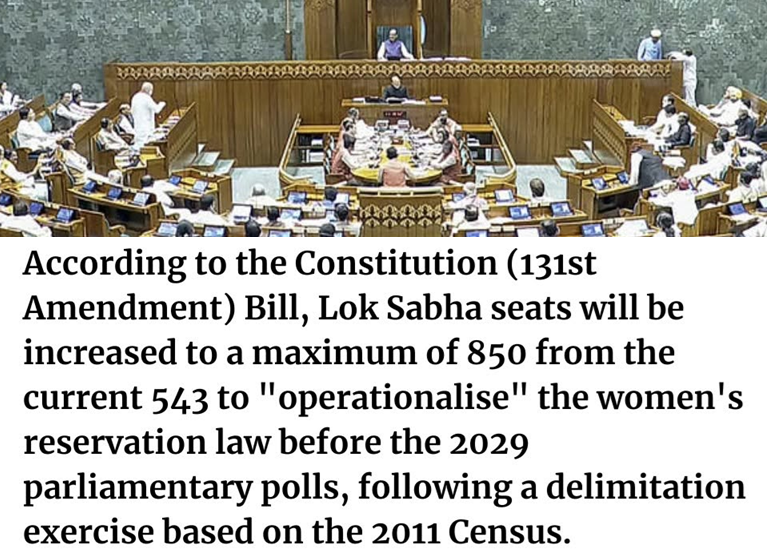
- It aims to increase the strength of the Lok Sabha to a maximum of 850 members, including up to 815 from States and 35 from Union Territories.
- Earlier, Article 81 limited the Lok Sabha strength to 530 members from States and 20 from Union Territories based on population.
- It removes the long-standing freeze on seat readjustment based on population that has been in effect since 1976.
- It allows delimitation to be carried out immediately by deleting the condition of waiting for the first Census after 2026.
- It states that the population for seat allocation will be based on a Census decided by Parliament.
- It assigns the responsibility of delimitation clearly to a Delimitation Commission instead of leaving it to Parliament to decide.
- It enables fresh readjustment of seats and redrawing of constituencies in State Legislative Assemblies under Article 170.
- It removes the third proviso of Article 170 which had postponed delimitation until after the 2026 Census.
- It ensures that constituency boundaries within States will be redrawn based on updated population data.
- It enables one-third reservation for women in the Lok Sabha and State Assemblies to be implemented immediately after delimitation.
- It amends Article 334A to remove the delay condition introduced by the 106th Amendment Act, 2023.
- It provides that women’s reservation will continue for 15 years from the commencement of the 106th Amendment unless extended by Parliament.
- It ensures that reserved constituencies for women will be rotated in future delimitation exercises.
- It provides safeguards to protect the representation of Scheduled Tribes in State Assemblies.
- It amends Article 332 to ensure that Scheduled Tribe seats are not reduced, especially in Northeastern States like Arunachal Pradesh, Meghalaya, Mizoram, Tripura and Nagaland.

Leave a Reply
Your Comment is awaiting moderation.