

PREVIOUS
✖
Creamy Layer – SC/ST Reservation Issue
May 2 , 2026
15 hrs 0 min
16
0
- Supreme Court of India issued notice to Centre and States on a PIL (Public Interest Litigation) seeking exclusion of a “creamy layer” from SC/ST reservations, based on the interpretation of State of Punjab v. Davinder Singh.
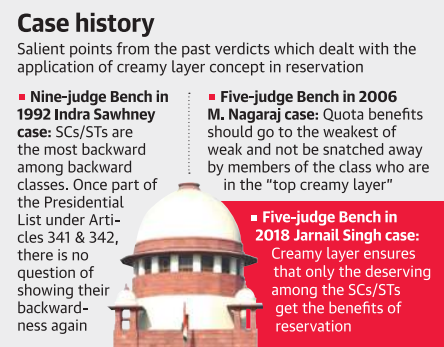
- The 7-judge Bench in Davinder Singh (2024) allowed sub-classification within Scheduled Castes (SC) to direct benefits to the most marginalized, not creamy layer exclusion.
- The creamy layer principle originated in Indra Sawhney v. Union of India, where OBC (Other Backward Classes) reservations were upheld, but advanced sections were excluded based on relative equality.
- 1993 OM (Office Memorandum) defined creamy layer mainly by status (Class I/II government posts), recognizing intergenerational institutional power; income was secondary and excluded salary and agricultural income.
- 2004 DoPT (Department of Personnel and Training) letter treated PSU salary as a disqualification, but it was struck down in Union of India v. Rohith Nathan, restoring status-based criteria and ruling parental salary alone cannot decide creamy layer.
- B. R. Ambedkar (1932 Lothian Committee note) called the exclusion of wealthy/educated SC persons “erroneous”, stating that caste status depends on community, not individual progress.
- At the 1936 Mahar Conference, he noted educated and wealthy persons from marginalized castes still face social exclusion in jobs and public life.
- Data from Jaishri Patil v. Union of India showed that even Group D employees were excluded from benefits due to income limits; the same ceiling treated ₹6 lakh and ₹24 lakh families equally.
- Impact of reservation is concentrated among less-educated SC members in rural areas, not an elite “creamy layer”.
- This creates a “creamy layer trap”: threshold excludes moderately stable families while caste-based disadvantages persist.
- Sub-classification identifies the least represented SC sub-groups, whereas creamy layer exclusion removes individuals based on parental income.
- Justice B. R. Gavai acknowledged that SC/ST criteria cannot be identical to OBC criteria.
- SC/ST representation in Group A Union posts is slightly below their population share and quota; backlog vacancies remain unfilled.
- Extending the creamy layer to SC/ST is argued as constitutionally and sociologically weak; Parliament has the authority to clarify that sub-classification and creamy layer are distinct mechanisms.

Leave a Reply
Your Comment is awaiting moderation.