

PREVIOUS
✖
Delimitation in Tamil Nadu
March 7 , 2026
28 days
331
0
- Tamil Nadu Assembly’s strength was fixed at 234 seats.
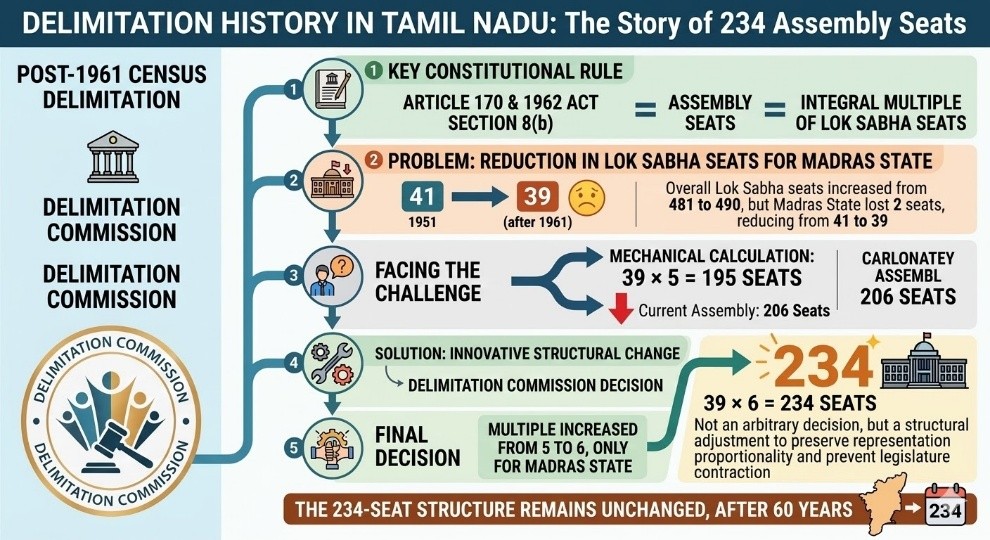
- This number was arrived at by the Delimitation Commission, which undertook the post-1961 Census redistribution of Lok Sabha and Assembly seats.
- Under Article 170 of the Constitution and Section 8(b) of the Delimitation Commission Act, 1962, the number of seats in a State Assembly must be an integral multiple of the number of Lok Sabha seats allotted to that State.
- At the time, 14 States together accounted for 481 parliamentary seats.
- Madras (as Tamil Nadu was known then) had 41.
- It was taking the overall total to 507 in the Lok Sabha.
- The Delimitation Commission was chaired by Justice J.L. Kapur, with C.P. Sinha and K.V.K. Sundaram as members.
- It noted that Article 81(1) fixed the maximum number of directly elected Lok Sabha members at 500.
- This meant the maximum seats available for allocation among the 14 States was 493.
- The total population of these States has increased very considerably during the last ten years.
- The average population per parliamentary constituency has increased from 732,654 in 1951 to 889,257 in 1961.
- After reviewing demographic changes revealed by the 1961 Census, the Commission concluded that retaining the existing 481 seats would disproportionately penalize some larger States.
- Uttar Pradesh, Andhra Pradesh and Madras would each have lost three seats, while Bihar would have lost one.
- To mitigate this, the Commission increased the total from 481 to 490.
- Even then, Uttar Pradesh, Andhra Pradesh and Madras lost two seats each, while Bihar avoided a loss.
- The Commission recorded that even raising the number to the constitutional ceiling of 493 would not have altered the losses faced by those States.
- Accordingly, Madras’ Lok Sabha strength was reduced from 41 to 39.
- The next step was to determine the size of the Madras Legislative Assembly.
- At that time, the State followed a multiple of five.
- It means each Lok Sabha constituency corresponded to five Assembly segments.
- Applying that formula mechanically would have resulted in: 39 × 5 = 195 Assembly seats.
- However, the Madras Assembly then had 206 elected members.
- Retaining the existing multiple would therefore have reduced the Assembly to 195 seats.
- It would be a significant contraction in representation.
- After due consideration, it was decided to retain the existing multiple in all States, except Madras.
- The commission thought that it would be proper to raise its multiple from 5 to 6 and to assign 234 seats to its Legislative Assembly.
- The revised formula thus became: 39 × 6 = 234.
- Instead of shrinking the seats of the Lok Sabha for the state, the Assembly seats in the state were expanded.
- The decision was not arbitrary.
- It was a structural adjustment designed to preserve proportionality between parliamentary and Assembly representation while preventing a drastic contraction of the State legislature.
- Six decades later, the 234-seat structure remains unchanged.

Leave a Reply
Your Comment is awaiting moderation.