

PREVIOUS
✖
End of START treaty
February 8 , 2026
12 hrs 0 min
20
0
- On February 5, the New Strategic Arms Reduction Treaty (New START) officially expired.
- It was marking the end of the last remaining bilateral agreement constraining the nuclear arsenals of the U.S. and Russia.
- The New START treaty emerged from a period of diplomatic reset between Washington and Moscow in the late 2000s.
- Its predecessor, START I, was signed in 1991 and expired in December 2009.
- Negotiations for a successor began in earnest in April 2009 after a meeting between then U.S. President Barack Obama and his Russian counterpart Dmitry Medvedev in London.
- In April 2010, the two leaders signed the treaty in Prague.
- And, after a contentious ratification process in the U.S. Senate and approval by the Russian Federal Assembly, entered into force on February 5, 2011.
- The treaty was originally set to expire in 2021.
- Just days before the deadline, the Biden administration and the Kremlin agreed to a one-time, five-year extension, moving the expiration date to February 5, 2026.
- It limited each side’s nuclear arsenal to 1,550 deployed strategic warheads.
- And it was a reduction of nearly 30% from the previous limit set in 2002.
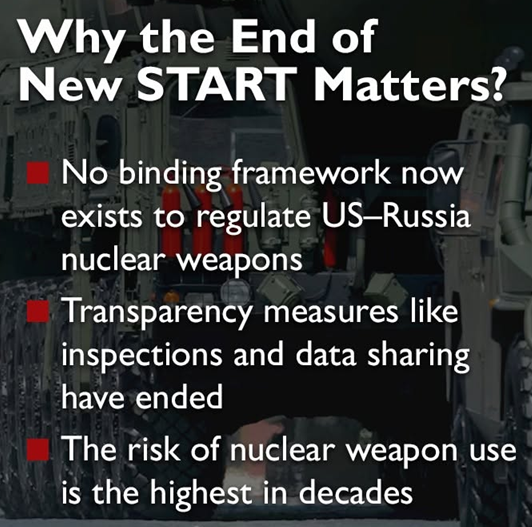
- Today, the legal constraints on the world’s two largest nuclear arsenals have dissolved.
- For the first time since 1972, there are no legally binding limits on the number of strategic nuclear weapons the U.S. and Russia can deploy.

Leave a Reply
Your Comment is awaiting moderation.