

PREVIOUS
✖
Farm Sector status in Tamil Nadu 2025
December 19 , 2025
15 hrs 0 min
72
0
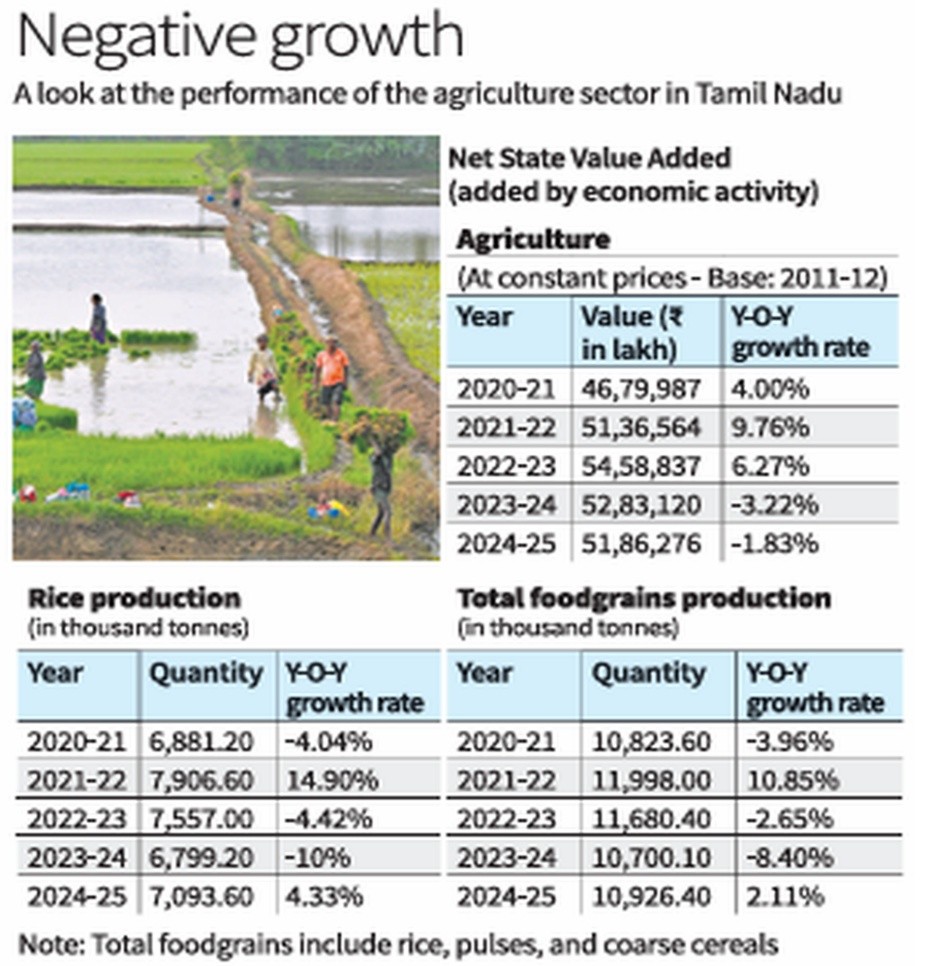
- Agriculture is the weak spot of Tamil Nadu’s economy and has recorded negative growth in the last two years, 2023–24 and 2024–25.
- This is based on the RBI Handbook of Statistics on Indian States.
- Despite weak agricultural performance, the State’s economy has grown well due to the strong performance of the secondary and tertiary sectors.
- Total food grain production (rice, pulses, and coarse cereals) ranged between 107 and 120 lakh tonnes.
- The highest production was 119.98 lakh tonnes in 2021–22, after the COVID-19 pandemic, and the lowest was 107 lakh tonnes in 2023–24.
- Rice is the main food grain in the State, followed by coarse cereals, especially millets, while pulses contribute only a small share.
- Production of rice and coarse cereals has remained largely stable over the years.
- Pulse production is low at around 3.6 lakh tonnes, compared to 7.5 lakh tonnes in 2014–15.
- Production of non-food crops such as cotton, sugarcane, and oilseeds has shown a declining trend.
- Oilseed production was about 11.5 lakh tonnes 20 years ago and has not crossed that level since.
- Cotton production declined to 2.1 lakh bales last year from 6.86 lakh bales in 2014–15.
- Sugarcane production fell sharply to about 133.5 lakh tonnes, compared to 411 lakh tonnes in 2006–07.
- Experts cite erratic monsoon conditions, market price fluctuations, lack of procurement for crops other than rice, and non-availability of new crop varieties as key reasons.
- Experts suggest giving more importance to horticultural crops, especially in rain-fed areas, to improve farm sector performance.

Leave a Reply
Your Comment is awaiting moderation.