

PREVIOUS
✖
Fossil Star - HE 1153−0518
November 29 , 2026
10 hrs 0 min
21
0
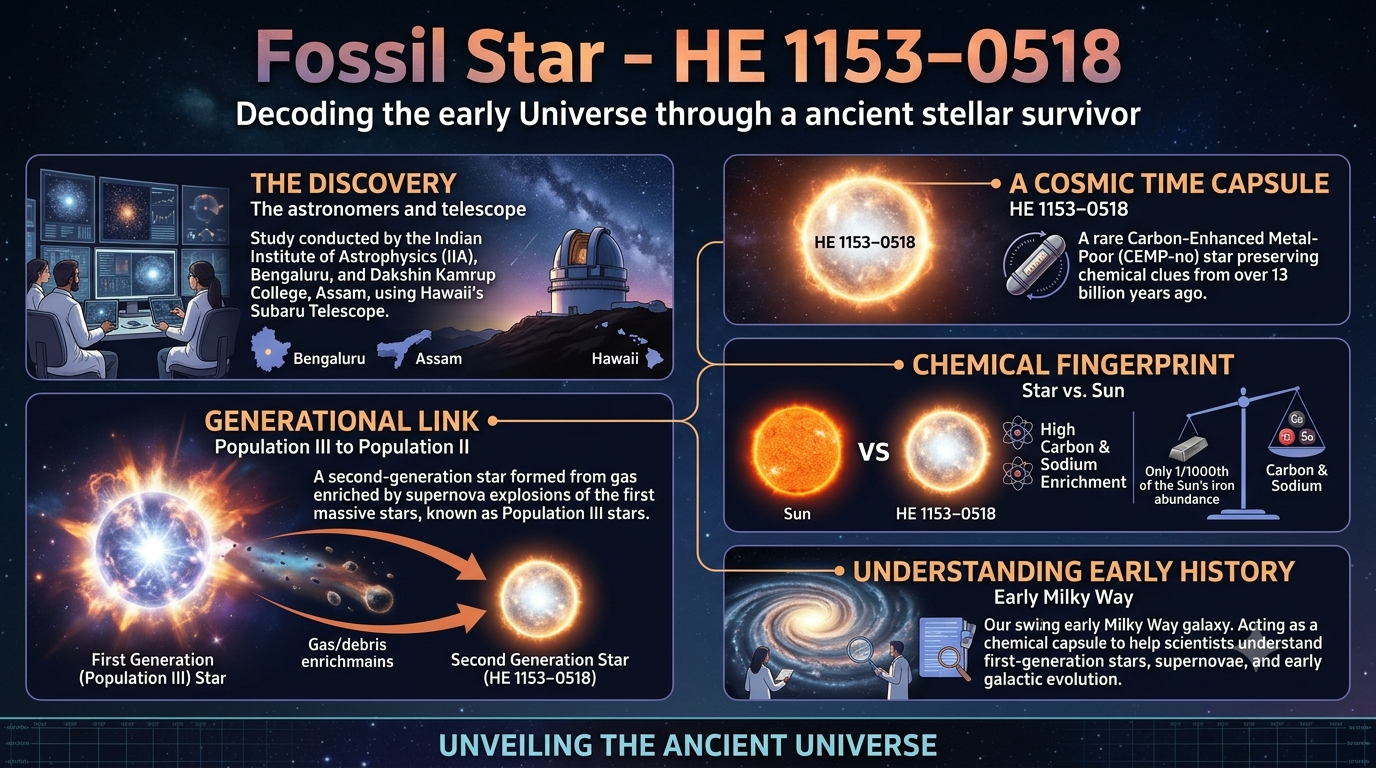
- Indian astronomers studied HE 1153−0518, a rare Carbon-Enhanced Metal-Poor (CEMP-no) star that preserves chemical clues about the Universe’s earliest stars, formed over 13 billion years ago.
- The study was conducted by researchers from the Indian Institute of Astrophysics (IIA), Bengaluru, and Dakshin Kamrup College, Assam, using data from the Subaru Telescope, Hawaii.
- It is a second-generation star formed from gas enriched by supernova explosions of the first massive stars, known as Population III stars.
- It contains only about one-thousandth of the Sun’s iron abundance and shows high carbon and sodium enrichment.
- It acts as a chemical time capsule, helping scientists understand the first stars, supernova explosions and the early chemical evolution of the Milky Way.

Leave a Reply
Your Comment is awaiting moderation.