

PREVIOUS
✖
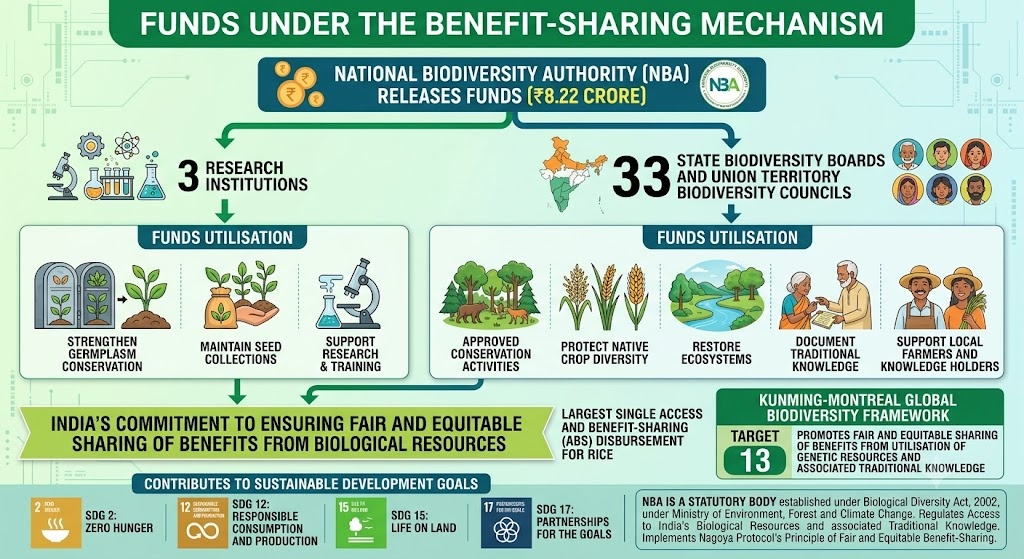
Funds under the benefit-sharing mechanism
August 10 , 2026
2 hrs 0 min
10
0
- The National Biodiversity Authority (NBA) has released funds (₹8.22 crore) to three research institutions and 33 State Biodiversity Boards and Union Territory Biodiversity Councils.
- It is marking one of the largest single access and benefit-sharing (ABS) disbursements for rice.
- This disbursement reflects India’s commitment to ensuring fair and equitable sharing of benefits arising from the utilisation of the country’s biological resources.
- The research institutions will utilise the funds to strengthen germplasm conservation, maintain seed collections and support research and training.
- The State Biodiversity Boards and Union Territory Biodiversity Councils will use their allocations for approved conservation activities, including protecting native crop diversity, restoring ecosystems, documenting traditional knowledge and supporting local farmers and knowledge holders.
- It supports Target 13 of the Kunming-Montreal Global Biodiversity Framework, which promotes fair and equitable sharing of benefits arising from the utilisation of genetic resources and associated traditional knowledge.
- It also contributes to several Sustainable Development Goals, including SDG 2 (Zero Hunger), SDG 12 (Responsible Consumption and Production), SDG 15 (Life on Land) and SDG 17 (Partnerships for the Goals).
- NBA is a statutory body established under the Biological Diversity Act, 2002, under the Ministry of Environment, Forest and Climate Change.
- It regulates access to India’s biological resources and associated traditional knowledge and implements the Nagoya Protocol’s principle of fair and equitable benefit-sharing.
CBD
- The Convention on Biological Diversity (CBD) is a global legal treaty from the 1992 Rio Earth Summit with three core goals - the conservation of biological diversity (or biodiversity); the sustainable use of its components; and the fair and equitable sharing of benefits arising from genetic resources.
- The United States is the only UN member state which has not ratified the Convention.
- It has two supplementary agreements, the Cartagena Protocol and the Nagoya Protocol.
- The Cartagena Protocol on Biosafety to the Convention on Biological Diversity is an international treaty governing the movements of living modified organisms (LMOs) resulting from modern biotechnology from one country to another.
- The Nagoya Protocol on Access to Genetic Resources and the Fair and Equitable Sharing of Benefits Arising from their Utilization (ABS) to the Convention on Biological Diversity is another supplementary agreement to the CBD.

Leave a Reply
Your Comment is awaiting moderation.