

PREVIOUS
✖
Global Aerosol Study and Climate Change
July 25 , 2026
15 hrs 0 min
119
0
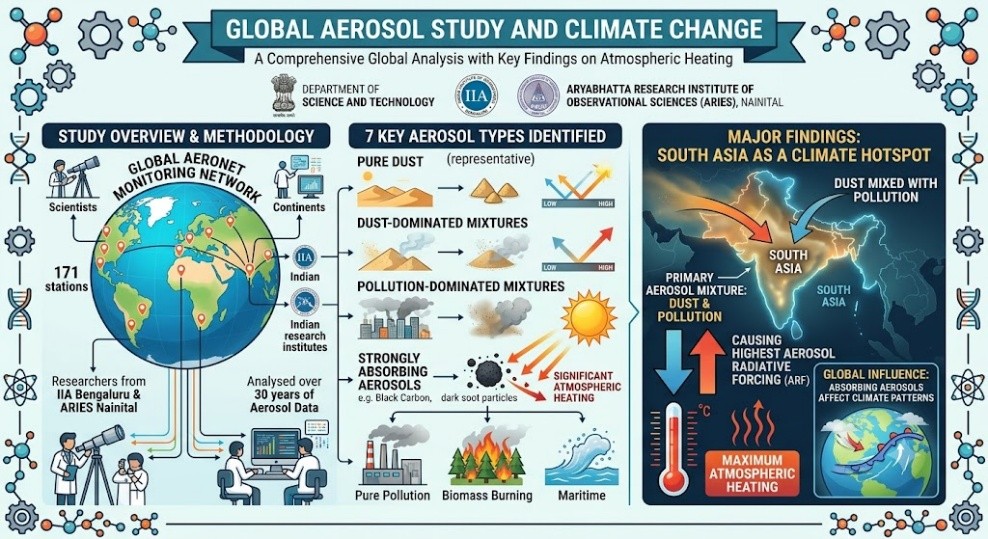
- A study on global aerosol diversity found that South Asia is mainly affected by dust mixed with pollution, causing the highest Aerosol Radiative Forcing (ARF) and atmospheric heating.
- The study was conducted by researchers from the Indian Institute of Astrophysics (IIA), Bengaluru and Aryabhatta Research Institute of Observational Sciences (ARIES), Nainital, under the Department of Science and Technology (DST).
- Researchers analysed aerosol data from 171 AERosol Robotic NETwork (AERONET) monitoring stations across six continents for over 30 years.
- Seven aerosol types were identified, including pure dust, dust-dominated mixtures, pollution-dominated mixtures, and strongly absorbing aerosols.
- Strongly absorbing aerosols, such as those containing black carbon, contribute significantly to atmospheric heating and influence climate patterns.

Leave a Reply
Your Comment is awaiting moderation.