

PREVIOUS
✖
Global Cryosphere Under Threat
November 7 , 2026
14 hrs 0 min
43
0
- Two reports released ahead of COP31, warned that global warming was causing irreversible damage to glaciers, ice sheets and permafrost.
- Reports: Overshoot and the Cryosphere: Averting Global Meltdown and State of the Cryosphere 2026: The Cost of Overshoot, released by the International Cryosphere Climate Initiative (ICCI) and the United Nations Environment Programme (UNEP).
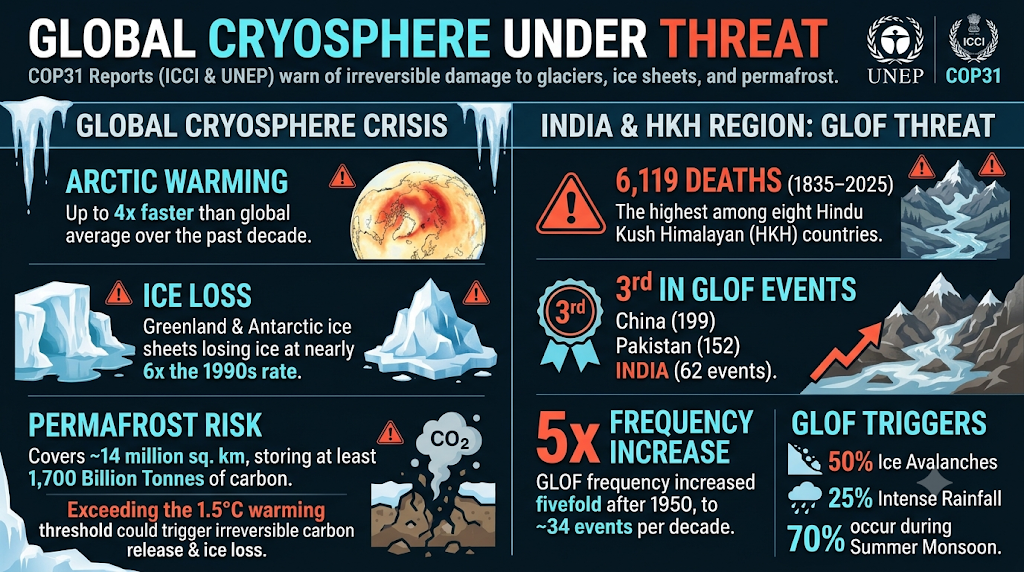
- The Arctic warmed up to 4 times faster than the global average over the past decade; the Greenland and Antarctic ice sheets lost ice at nearly 6 times the rate recorded in the 1990s.
- Exceeding the Paris Agreement’s 1.5°C warming threshold, even temporarily, could trigger irreversible ice loss and massive carbon release from permafrost.
- Permafrost covers about 14 million sq. km of the Northern Hemisphere and stores at least 1,700 billion tonnes of carbon.
- India recorded 6,119 deaths from Glacial Lake Outburst Floods (GLOFs) between 1835 and 2025 — the highest among eight Hindu Kush Himalayan countries.
- India ranked third in recorded GLOF events (62), after China (199) and Pakistan (152); the frequency of GLOFs increased fivefold after 1950 to around 34 events per decade.
- Ice avalanches triggered 50% of recorded GLOFs, intense rainfall 25%, and about 70% occurred during the summer monsoon.

Leave a Reply
Your Comment is awaiting moderation.