

PREVIOUS
✖
Global Value Chain Development Report 2025
December 19 , 2025
2 days
68
0
- The report “Rewiring GVCs in a Changing Global Economy” was jointly published by the Asian Development Bank (ADB), World Trade Organization (WTO), and World Economic Forum (WEF).
- Global Value Chains (GVCs) are production sequences for a final consumer good, with each stage adding value, and at least two stages occurring in different countries.
- GVCs are being rewired, not reversed, due to the technological change, green transition, and shifting geopolitical conditions.
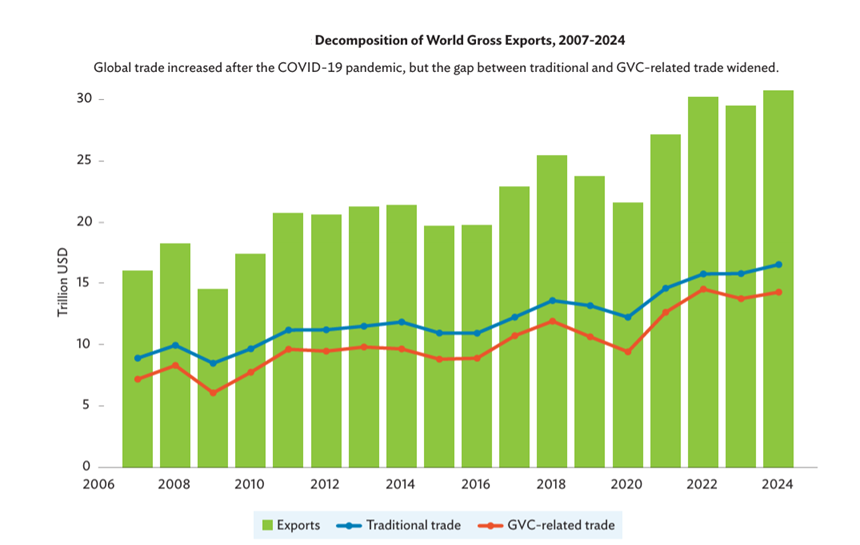
- The global share of GVCs in trade is 46.3%, slightly down from 48% in 2022.
- Services and digital trade now account for more than one-third of value added in manufacturing exports.
- Regional hubs dominate GVC trade: Asia, Europe, and North America; Latin America and Africa lag behind.
- Emerging trends include reshoring by China, the US, and the EU, and diversification of manufacturing despite China’s dominance in sectors like electric vehicles (EVs) production (76.9% globally).
- India is among the top 10 value-adding economies, accounting for 2.8% of global domestic value added in exports (2024).
- GVC participation contributes to poverty reduction, with a 1% increase boosting per capita income twice as much as conventional trade.
- GVCs promote employment creation, especially labour-intensive and female-driven jobs, as seen in Bangladesh’s export apparel sector.

Leave a Reply
Your Comment is awaiting moderation.