

PREVIOUS
✖
Harappan Civilization Decline
August 2 , 2026
9 hrs 0 min
28
0
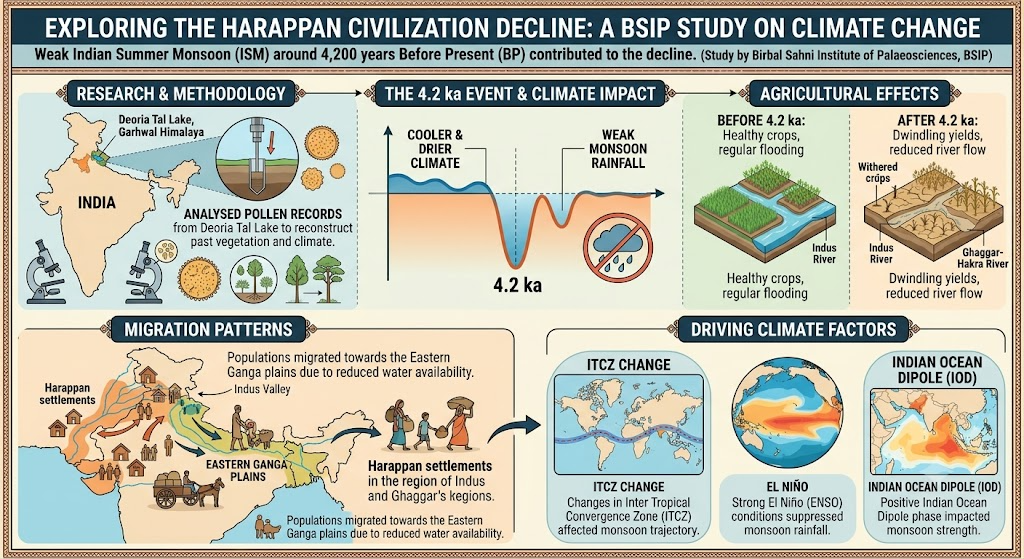
- A study by the Birbal Sahni Institute of Palaeosciences (BSIP) found that a weak Indian Summer Monsoon (ISM) around 4,200 years Before Present (BP) contributed to the decline of the Harappan Civilization.
- Researchers analysed pollen records from Deoria Tal Lake, Garhwal Himalaya, to reconstruct past vegetation and climate changes.
- The study found that the 4.2 ka event caused a cooler and drier climate, weakening monsoon rainfall and affecting agriculture in the Indus and Ghaggar-Hakra river regions.
- Due to reduced river flooding and water availability, Harappan populations migrated towards the eastern Ganga plains.
- The study linked the climate shift to factors such as changes in the Inter Tropical Convergence Zone (ITCZ), El Niño, and Indian Ocean Dipole (IOD).

Leave a Reply
Your Comment is awaiting moderation.