

PREVIOUS
✖
Heat to Electricity Breakthrough
September 8 , 2026
15 hrs 0 min
38
0
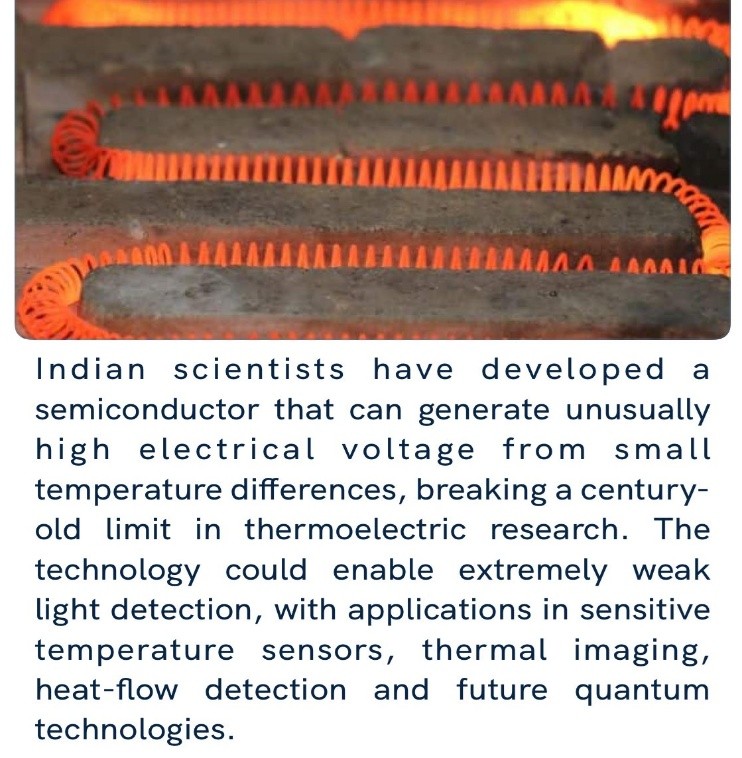
- Scientists from Jawaharlal Nehru Centre for Advanced Scientific Research (JNCASR), University of Sydney and Indian Institute of Science (IISc) developed a crystal that produces nearly 1,000 times higher thermoelectric voltage than the textbook limit.
- They used scandium nitride (ScN) thin films doped with magnesium to create a heavily doped, highly compensated semiconductor.
- The discovery challenges the long-accepted limit of the Seebeck effect, which converts a temperature difference into electrical voltage.
- The material can support ultrasensitive temperature sensors, heat detectors and quantum sensing devices.
- The films were confirmed to be single-crystalline and epitaxial using X-ray diffraction and atomic-resolution electron microscopy.

Leave a Reply
Your Comment is awaiting moderation.