

PREVIOUS
✖
Historic agreement on Narmada River
July 11 , 2026
14 hrs 0 min
9
0
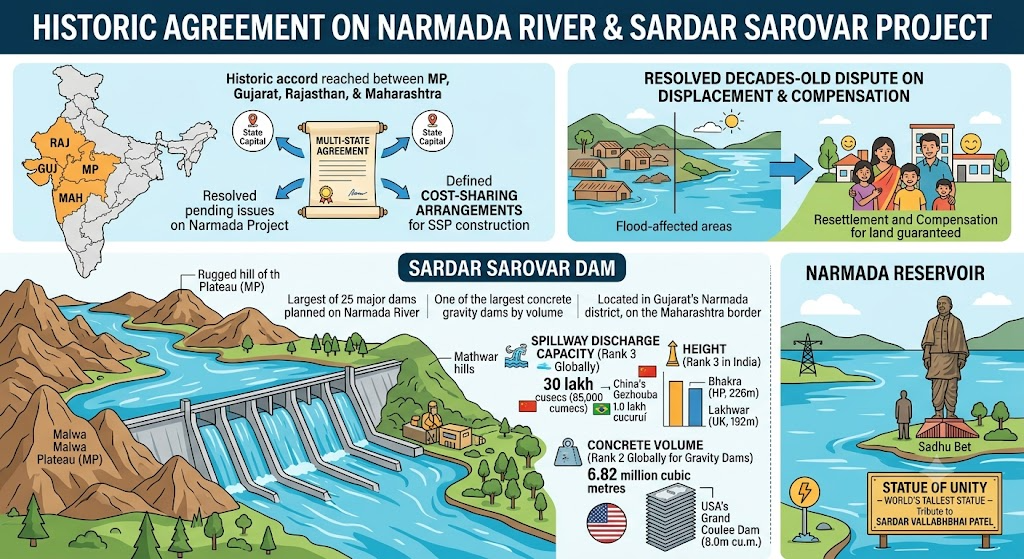
- Madhya Pradesh, Gujarat, Rajasthan, and Maharashtra governments reached an agreement on pending issues related to the Narmada Project.
- It relates to the cost-sharing arrangements for the construction of the Sardar Sarovar Project.
- This also resolved the decades-old dispute regarding the displacement of people from flood-affected areas and compensation for land in the Narmada River Project.
- The Sardar Sarovar Dam is one of 25 major dams planned on the Narmada River and stands as the largest among them.
- It is the one of the largest concrete dam in the world by the volume of concrete used in its construction.
- Sardar Sarovar Dam is located in Gujarat’s Narmada district, right on the border between Gujarat and Maharashtra.
- To its west lies the Malwa plateau of Madhya Pradesh, where the Narmada River cuts through rugged hill tracts before reaching the Mathwar hills.
- With a spillway discharge capacity of 30 lakh cusecs (85,000 cumecs), it ranks third in the world, behind China’s Gezhouba (1.13 lakh cumecs) and Brazil’s Tucuruí (1.0 lakh cumecs).
- At 163 metres, the dam is India’s third-highest concrete dam, after Bhakra (226 metres) in Himachal Pradesh and Lakhwar (192 metres) in Uttarakhand.
- By volume of concrete used in a gravity dam, it is the second largest globally with 6.82 million cubic metres — only the Grand Coulee Dam in the United States (8.0 million cu.m.) is larger.
- Overlooking the reservoir stands the Statue of Unity, the world’s tallest statue, built as a tribute to Sardar Vallabhbhai Patel.

Leave a Reply
Your Comment is awaiting moderation.