

PREVIOUS
✖
Majority Support in the Legislative Assembly
May 10 , 2026
16 hrs 0 min
16
0
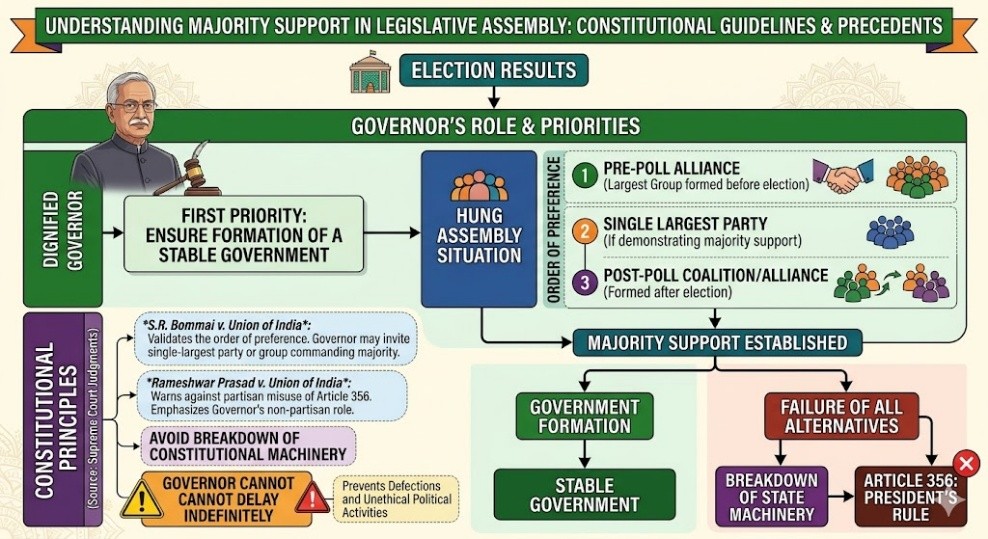
- The Supreme Court of India stated that a Governor’s first priority is to ensure the formation of a stable government.
- The demand that C. Joseph Vijay prove majority support in the Legislative Assembly is based on constitutional principles.
- A stable government is necessary to avoid a breakdown of constitutional machinery and the imposition of President’s Rule.
- Supreme Court judgments have stated that a Governor cannot refuse government formation once majority support is established.
- The only exception is when the Governor believes that the claimants cannot provide a stable government.
- The court also observed that a Governor should not wait indefinitely, as it may encourage defections and unethical political activities.
- The Sarkaria Commission and the Supreme Court supported giving Governors a reasonable time to explore alternatives for government formation.
- The Constitution does not clearly define the term “reasonable time.”
- In a hung Assembly, the Governor’s first preference is a pre-poll alliance with the largest number of seats.
- The second option is the single-largest party if it can demonstrate majority support.
- A post-poll coalition or alliance becomes the final option for government formation.
- In the S. R. Bommai v. Union of India judgment, a nine-judge Bench approved this order of preference.
- The judgment also clarified that the Governor may invite either the single-largest party or a group commanding majority support.
- The court stated that it does not matter whether the group was formed before or after the election.
- Failure of all alternatives to secure majority support may lead to constitutional breakdown in the State.
- In the Rameshwar Prasad v. Union of India case, the Supreme Court warned Governors against partisan misuse of constitutional powers.
- The judgment referred to the criticism made by the Sarkaria Commission regarding the misuse of Article 356.
- The Commission observed that Governors had sometimes recommended President’s Rule to favour the ruling party at the Centre.
- Article 356 deals with the imposition of President’s Rule in states.
- Supreme Court judgments have recognised that coalition governments have become common in Indian politics.

Leave a Reply
Your Comment is awaiting moderation.