

PREVIOUS
✖
Mega Earth GJ 523b
August 24 , 2026
12 hrs 0 min
10
0
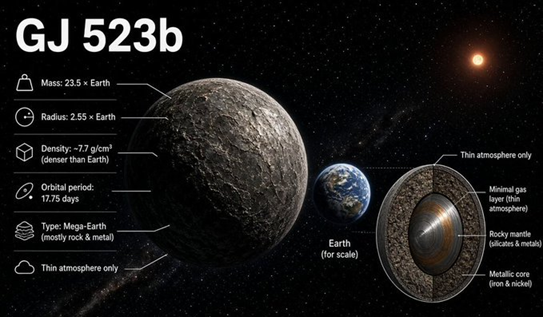
- Scientists have identified GJ 523b, an exoplanet classified as a “mega-Earth”.
- It has a radius about 2.55 times Earth’s, a mass of 23.5 Earth masses, and a density of about 7.8 g/cm³.
- It orbits a mid-K dwarf star once every 17.75 days, with an estimated equilibrium temperature of 538 K.
- Its properties were determined using transit observations from NASA’s Transiting Exoplanet Survey Satellite (TESS) and radial velocity measurements from the NEID spectrograph on the WIYN 3.5-metre Telescope.
- A “mega-Earth” is a rocky exoplanet with a radius of at least 2.1 Earth radii and density of at least 5.5 g/cm³.
- The planetary system is estimated to be 169 million years old; its unusually massive rocky nature challenges expectations that such a planet would develop a thick gas envelope.

Leave a Reply
Your Comment is awaiting moderation.