

PREVIOUS
✖
Minority Government in Tamil Nadu
May 10 , 2026
16 hrs 0 min
18
0
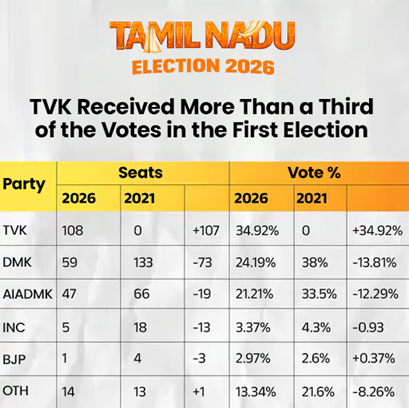
- The Tamilaga Vettri Kazhagam (TVK) failed to secure the required majority in the Tamil Nadu Assembly to independently form the government.
- TVK won 108 seats in the 234-member Assembly.
- Since Vijay was elected from both Perambur and Tiruchi (East), the party’s effective strength stands reduced to 107 seats.
- In 2006, the Dravida Munnetra Kazhagam (DMK) formed the government despite winning only 96 seats, with support from allies holding 68 seats.
- DMK allies had submitted letters of support to Governor Surjit Singh Barnala.
- The precedent of inviting the single-largest party to form the government dates back to 1952.
- In 1952, the Indian National Congress formed the government in Madras State under C. Rajagopalachari, despite securing only 152 seats in a 375-member Assembly.
- The Congress strength later increased to 165 members by the time the Assembly was constituted.
- M.A. Manickavelu Naicker of the Commonweal Party was included in Raja Gopalachari’s Cabinet.
- In July 1979, President Neelam Sanjiva Reddy consulted party leaders after the fall of the Janata Party government led by Morarji Desai.
- Opposition leader Yashwantrao Balwantrao Chavan expressed an inability to form the government.
- Subsequently, Charan Singh was invited to form the government.
- In November 1990, President Ramaswamy Venkataraman sought views from major parties after the fall of the government led by Vishwanath Pratap Singh.
- After the major parties declined, Chandra Shekhar was invited to form the government.
- If no party can form a stable government, the Governor may recommend President’s Rule and keep the Assembly under suspended animation or dissolve it.
- The Punchhi Commission recommended that the party or coalition commanding the widest support in the Assembly should be invited to form the government.
- The Commission suggested preference for government formation in the following order:
- Pre-poll alliance with the largest support.
- Largest single party with outside support.
- Post-poll coalition with all partners in government.
- Post-poll alliance with some parties in government and others offering outside support.

Leave a Reply
Your Comment is awaiting moderation.