

PREVIOUS
✖
Model Code of Conduct 2026
March 17 , 2026
14 hrs 0 min
18
0
- The announcement of the Tamil Nadu Assembly election schedule was made on March 15.
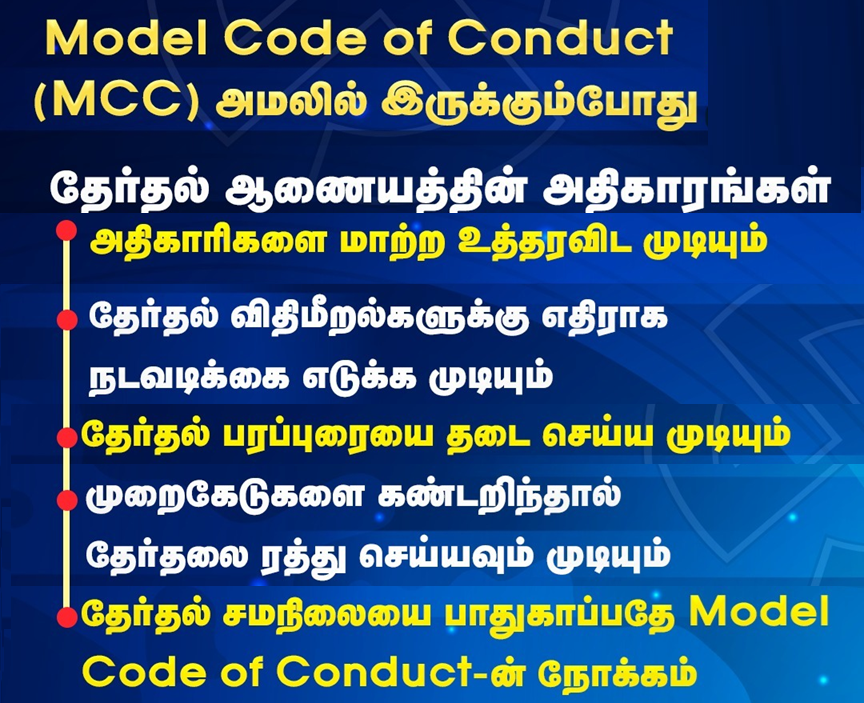
- Consequent to the announcement of the election schedule, the Model Code of Conduct (MCC) came into force in Tamil Nadu in the evening.
- The Model Code of Conduct (MCC) is a set of rules issued by the Election Commission to guide political parties and candidates during elections.
- This is in keeping with Article 324 of the Constitution, which gives the Election Commission the power to supervise elections to the Parliament and state legislatures.
- The model code of conduct consists of seven sections which deal with general conduct, meetings, processions, party in power, polling booth, polling day and election manifestos.
Impact of Model Code of Conduct
- It would be applicable to all candidates, political parties, and the State and Union governments.
- District Election Officers (DEOs) have been directed to obtain information on unusual and suspicious withdrawal or deposit of cash exceeding ₹1 lakh at banks for due verification.
- The ruling government cannot sanction new projects, announce financial grants, or utilize government vehicles/staff for political campaigns.
- No campaigning is allowed within 100 meters of polling stations.
- Public meetings and rallies are prohibited 48 hours before the poll closes.
- Vehicles used for campaigning must be registered with district administration, and illegal use or voter transportation is punished.
- Organizers must inform the local police well in advance, detailing routes, timing, and using designated spaces impartially.
- Candidates and parties must avoid activities that cause conflict, such as criticizing other parties' private lives or conducting protests at opponents' houses.
- No appeals to religion, caste, or communal sentiments.
- Criticism must focus on policies, performance, and programmes, not private lives.
- Official mass media cannot be used for biased coverage favoring the ruling party.
- Illegal activities like bribing, intimidation, impersonation, or campaigning near polling stations are prohibited.
- Demonstrations outside private homes or use of someone else's property for campaigning are banned.
- Parties must inform authorities about meetings and processions; permissions for loudspeakers or gatherings must be obtained.
- Police instructions must be followed to maintain peace and manage traffic.
- Processions must follow pre-decided routes, timings, and start/end points.
- Carrying harmful objects or burning effigies is prohibited.
- Parties must avoid clashes with other processions.
- Parties and candidates must cooperate with election officials during polling.
- No propaganda, liquor, or crowding near polling booths; camps must remain simple and free of political symbols.
- Governments cannot use official machinery, funds, or positions for campaigning.
- No announcements of financial grants, new projects, infrastructure promises, or ad-hoc appointments that could influence voters.
- Government facilities, including transport, rest houses, dak bungalows, and public spaces, must be equally available to all parties.
- Election manifestos must follow constitutional principles, be realistic, and cannot be released during the prohibited period before polling.
Background
- The birth of the Model Code of Conduct dates back to the Assembly elections of Kerala in 1960, during which the State administration drafted a 'Code of Conduct' for political actors.
- In the 1962 general elections to the Lok Sabha, the MCC was circulated by the Election Commission of India to recognised parties, and state governments.
- The MCC was largely followed by all parties in the 1962 elections and continued to be followed in subsequent general elections.
- In 1979, the Election Commission added a section to regulate the ‘party in power’ and prevent it from gaining an unfair advantage at the time of elections.
- It was the year 1991 when the Election Commission decided to make more stringent use of the Model Code of Conduct following repeated election norms violations and continued corruption.
- In 2013, the Supreme Court directed the Election Commission to include guidelines regarding election manifestos, which it had included in the MCC for the 2014 general elections.
- The MCC is not enforceable by law.
- However, certain provisions of the MCC may be enforced through invoking corresponding provisions in other statutes such as the Indian Penal Code, 1860, Code of Criminal Procedure, 1973, and Representation of the People Act, 1951.
- The Election Commission has argued against making the MCC legally binding; stating that elections must be completed within a relatively short time (close to 45 days), and judicial proceedings typically take longer, therefore it is not feasible to make it enforceable by law.
- The MCC contains eight provisions dealing with general conduct, meetings, processions, polling day, polling booths, observers, party in power, and election manifestos.
- Major provisions of the MCC are outlined below.
- General Conduct: Criticism of political parties must be limited to their policies and programmes, past record and work.
- Activities such as: (a) using caste and communal feelings to secure votes, (b) criticising candidates on the basis of unverified reports, (c) bribing or intimidation of voters, and (d) organising demonstrations or picketing outside houses of persons to protest against their opinions, are prohibited.
- Meetings: Parties must inform the local police authorities of the venue and time of any meeting in time to enable the police to make adequate security arrangements.
- Processions: If two or more candidates plan processions along the same route, organisers must establish contact in advance to ensure that the processions do not clash. Carrying and burning effigies representing members of other political parties is not allowed.
- Polling day: All authorized party workers at polling booths should be given identity badges. These should not contain the party name, symbol or name of the candidate.
- Polling booths: Only voters, and those with a valid pass from the Election Commission, will be allowed to enter polling booths.
- Observers: The Election Commission will appoint observers to whom any candidates may report problems regarding the conduct of the election.
- Party in power: The MCC incorporated certain restrictions in 1979, regulating the conduct of the party in power. Ministers must not combine official visits with election work or use official machinery for the same. The party must avoid advertising at the cost of the public exchequer or using official mass media for publicity on achievements to improve chances of victory in the elections. Ministers and other authorities must not announce any financial grants, or promise any construction of roads, provision of drinking water, etc. Other parties must be allowed to use public spaces and rest houses and these must not be monopolized by the party in power.
- Election manifestos: Added in 2013, these guidelines prohibit parties from making promises that exert an undue influence on voters, and suggest that manifestos also indicate the means to achieve promises.
Leave a Reply
Your Comment is awaiting moderation.