

PREVIOUS
✖
New Exoplanet - Beta Pictoris d
July 23 , 2026
16 hrs 0 min
20
0
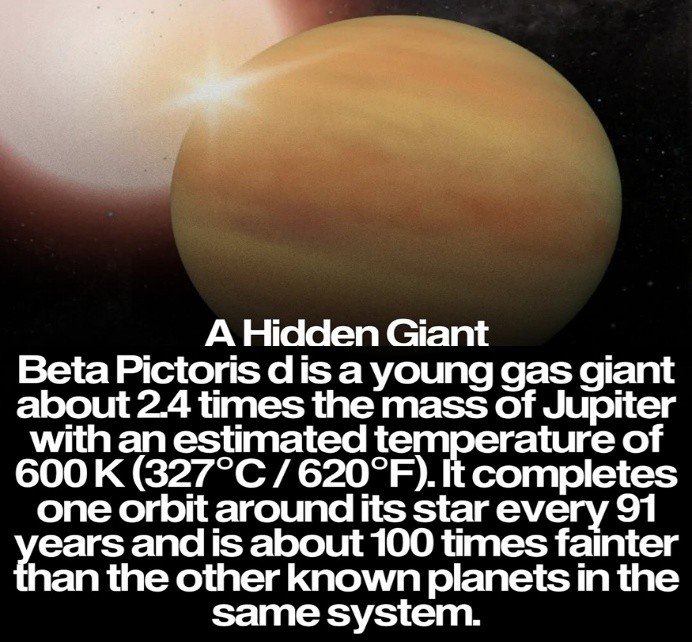
- Astronomers using NASA's James Webb Space Telescope (JWST) discovered a new giant exoplanet, Beta Pictoris d, in the Beta Pictoris system.
- Beta Pictoris is a 23-million-year-old star system located 63 light-years away, known for its bright debris disc; it is now only the second planetary system with three directly imaged planets.
- Beta Pictoris d was detected using JWST's Near-Infrared Spectrograph (NIRSpec) through atmospheric carbon monoxide, later confirmed by water vapour and methane observations with the Mid-Infrared Instrument (MIRI).
- The planet has about 2 times Jupiter's mass and orbits at about 30 astronomical units (AU) from its star, near the inner edge of the debris disc.
- It is the first exoplanet discovered primarily through moderate-resolution spectroscopy, demonstrating a new method of detecting planets using atmospheric fingerprints.

Leave a Reply
Your Comment is awaiting moderation.