

PREVIOUS
✖
NFHS-6 findings
June 13 , 2026
15 hrs 0 min
15
0
- India’s latest National Family Health Survey (NFHS-6) records gains in child nutrition, maternal care, institutional births and women’s internet use.
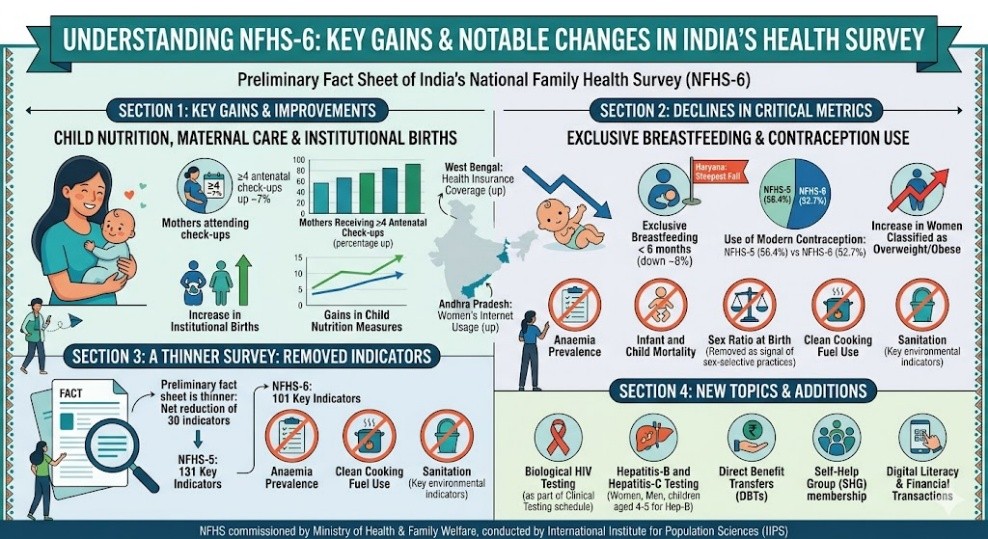
- But its preliminary fact sheet is also thinner than the last round, with 101 indicators compared with 131 in NFHS-5.
- Key indicators such as Anaemia, mortality, sex ratio at birth, sanitation, and clean cooking fuel have been removed from the survey.
- The Union Health Ministry released the fact sheets of NFHS-6 on May 29, covering 2023-24.
- The survey recorded data from nearly 6.8 lakh households across every State and Union Territory except Manipur.
- The NFHS is commissioned by the Ministry of Health and Family Welfare.
- It designates the International Institute for Population Sciences (IIPS) to conduct the survey.
- Preliminary findings report clear gains on several measures, including mothers getting at least four antenatal check-ups, up about seven percentage points from NFHS-5, an increase in institutional births and women’s internet usage.
- It also points to declines in several metrics, such as exclusive breastfeeding of infants under six months, down nearly eight percentage points, and the use of modern contraception, down to 52.7% from 56.4%.
- NFHS-4 in 2015-16 introduced district-level estimates and tablet-based digital interviewing for survey collection.
- NFHS-5 pushed the indicators further, including new topics, such as preschool education, disability, access to a toilet facility, death registration, bathing practices during menstruation and methods and reasons for abortion.
- It also extended blood pressure and blood sugar measurements from adults aged between 15 and 49 to all adults aged 15 and above. The survey measured 131 key indicators, up from 114 in NFHS-4.
- While the HIV testing component was dropped from NFHS-5, it retained questions on HIV/AIDS knowledge, attitudes, prior testing, sexually transmitted infections, and sexual behaviour.
- In NFHS-6, biological HIV testing has been brought back as part of the clinical, anthropometric and biochemical testing schedule.
- The NFHS-6 fact sheet does not separately spell out whether all HIV/AIDS knowledge and attitude questions were retained.
- NFHS-6 also added new questions on direct benefit transfers, self-help group memberships, digital literacy and financial transactions.
- It also includes testing for Hepatitis-B and Hepatitis-C among women and men, as well as dried blood spot collection from children aged 4-5 for Hepatitis-B testing.
- But for the first time, the survey has also subtracted overall, showing a net reduction of 30 indicators in the preliminary results.
- Among the dropped indicators, the most notable ones, such as Anaemia, infant and child mortality, sex ratio at birth, clean cooking fuel use, and sanitation, have all appeared since at least NFHS-4.
- Between NFHS-4 in 2015-16 and NFHS-5 in 2019-21, anaemia rose across the board.
- Among children, anaemia prevalence went up from 58.6% to 67.1%, among women aged 15-49, it rose from 53.1% to 57%, and among pregnant women, anaemia rose from 50.4% to 52.2%.
- The rise in anaemia was near-universal across the country, with child anaemia increasing in 28 States and Union Territories, and in some cases by big leaps, from 35.7% to 68.4% in Assam and 19.3% to 46.4% in Mizoram.
- The three mortality indicators — neonatal, infant and under-five — have also been cut, but these will be tracked by the Sample Registration System, whose latest bulletin put infant mortality at 24 per 1,000 live births.
- The Registration System, however, does not carry district-level data and socio-economic breakdowns that are available in NFHS.
- The sex ratio of the total population and the sex ratio at birth, 929 females per 1,000 males in NFHS-5, are both absent, removing a standard signal of sex-selective practices.
- Four cancer-screening indicators, covering cervical, breast and oral cancer, introduced only in NFHS-5 are gone after a single round.
- NFHS-6 reported a drop in the number of women who have experienced spousal violence.
- Health insurance coverage rose the most in West Bengal, from 33.7% of households in NFHS-5 to 88.2% in NFHS-6.
- Women’s internet use saw its largest increase in Andhra Pradesh, from 21% to 63.6%.
- Haryana recorded the steepest fall in exclusive breastfeeding among infants under six months, from 69.5% to 41.2%.
- The share of women classified as overweight or obese increased in every State.

Leave a Reply
Your Comment is awaiting moderation.