

PREVIOUS
✖
NHRC Advisory 2.0
May 22 , 2026
13 hrs 0 min
51
0
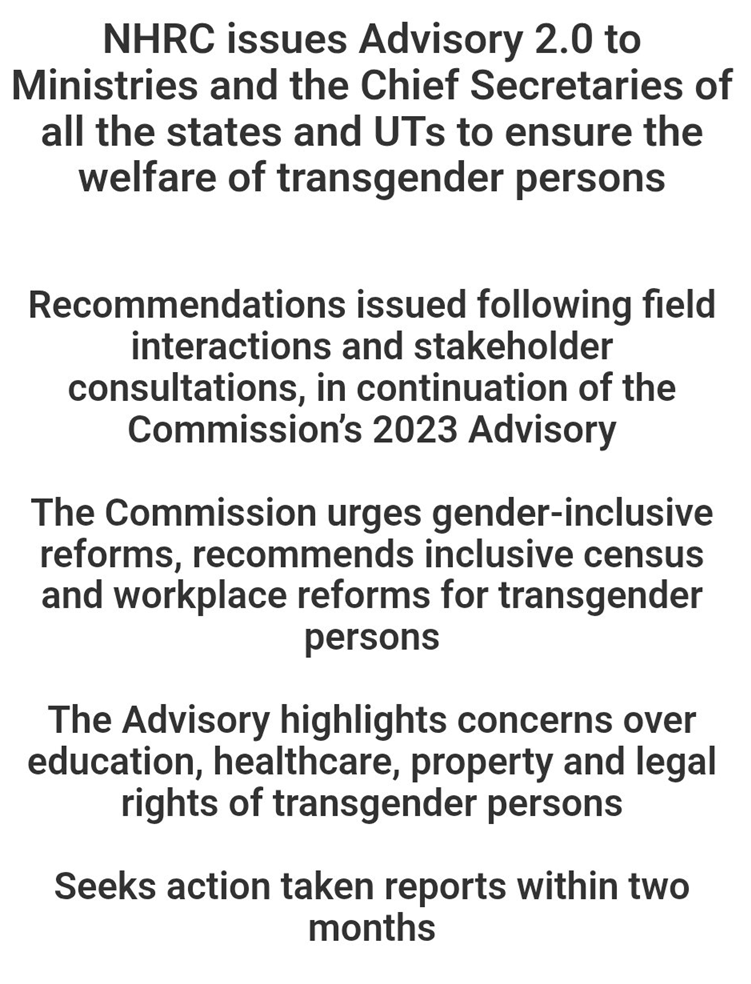
- The National Human Rights Commission (NHRC) issues Advisory 2.0 to states and UTs to ensure the welfare of transgender persons
- The Advisory focuses on ten key areas for action to ensure the welfare of transgender persons.
- The key recommendations are as follows:
- Inclusion of distinct categories such as ‘Intersex’, ‘Transmen’ and ‘Transwomen’ in the upcoming Census of India and other national surveys to ensure accurate and inclusive gender-disaggregated data collection;
- Review of laws, including the Registration of Births and Deaths Act, Juvenile Justice Act and succession laws, to ensure recognition of self-identified gender and protection of the rights of transgender and intersex persons;
- Ensuring equal inheritance, succession, housing and property rights for transgender and intersex persons without discrimination;
- Developing comprehensive SOPs for police and correctional institutions regarding arrest, detention, searches, interrogations, imprisonment, confidentiality and access to gender-affirming healthcare for transgender persons;
- Establishing dedicated legal aid cells, helplines and independent grievance-redressal mechanisms for transgender and gender-diverse persons facing discrimination, violence or custodial abuse;
- Admission of transgender students in educational institutions based on self-identified gender without requiring medical proof, along with the creation of gender-neutral facilities and grievance-redressal mechanisms;
- Mandatory gender-sensitization training for teachers, counsellors, police, prison personnel, judicial officers and healthcare professionals to promote inclusion and reduce discrimination;
- Developing standardized and ethical medical protocols for gender-affirming healthcare, regulation of Sex Reassignment Surgery costs and equal insurance coverage for transgender healthcare needs;
- Prohibition of coercive or non-consensual medical procedures on intersex children, except in life-saving situations, while ensuring counselling and psychosocial support for parents;
- Promoting inclusive workplaces through gender-neutral facilities, inclusive Human Resource policies, workplace grievance mechanisms and mandatory diversity disclosures, alongside welfare measures for elderly transgender persons; and
- Simplifying the documentation process and enabling self-identification-based enrolment for elderly transgender persons in welfare schemes and establishing transgender-inclusive old-age homes and community shelters, ensuring privacy, healthcare access, social interaction and emotional well-being.

Leave a Reply
Your Comment is awaiting moderation.