

PREVIOUS
✖
Right to Trauma Care – Supreme Court Judgment
June 26 , 2026
6 hrs 0 min
47
0
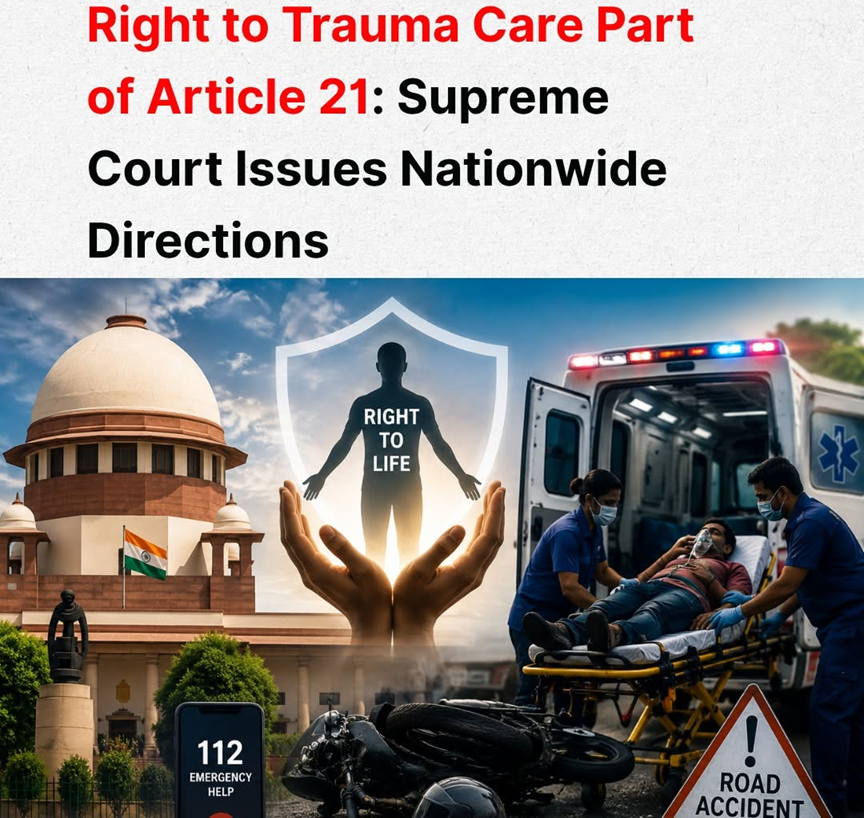
- The Supreme Court in SaveLIFE Foundation & Anr. vs Union of India held that the right to trauma care is an integral part of the Right to Life under Article 21 of the Constitution of India.
- The Court ruled that the right to trauma care covers the entire emergency response chain from the site of injury to definitive hospital treatment.
- It issued nine binding directions to the Union Government, States, and Union Territories with implementation timelines of 3–6 months.
- All States must integrate emergency helplines such as 100, 101, 102, 108, and 1091 into a single national emergency number 112.
- All ambulances must comply with the National Ambulance Code, be equipped with GPS tracking, and be integrated with the 112 emergency response system.
- States must implement cashless treatment for road accident victims under the PM RAHAT (Prime Minister–Road Accident Victims’ Hospitalisation and Assured Treatment) scheme.
- The Court observed that trauma is the leading cause of death among Indians aged 18–45 years.
- In Parmanand Katara vs Union of India (1989), the Supreme Court held that doctors have a duty to provide immediate emergency medical aid.
- In Paschim Banga Khet Mazdoor Samiti vs State of West Bengal (1996), the Court expanded Article 21 to include access to emergency medical care.
- The present judgment further expands Article 21 to include the complete emergency care chain: bystander assistance, emergency call, ambulance services, paramedics, and hospital treatment.

Leave a Reply
Your Comment is awaiting moderation.