

PREVIOUS
✖
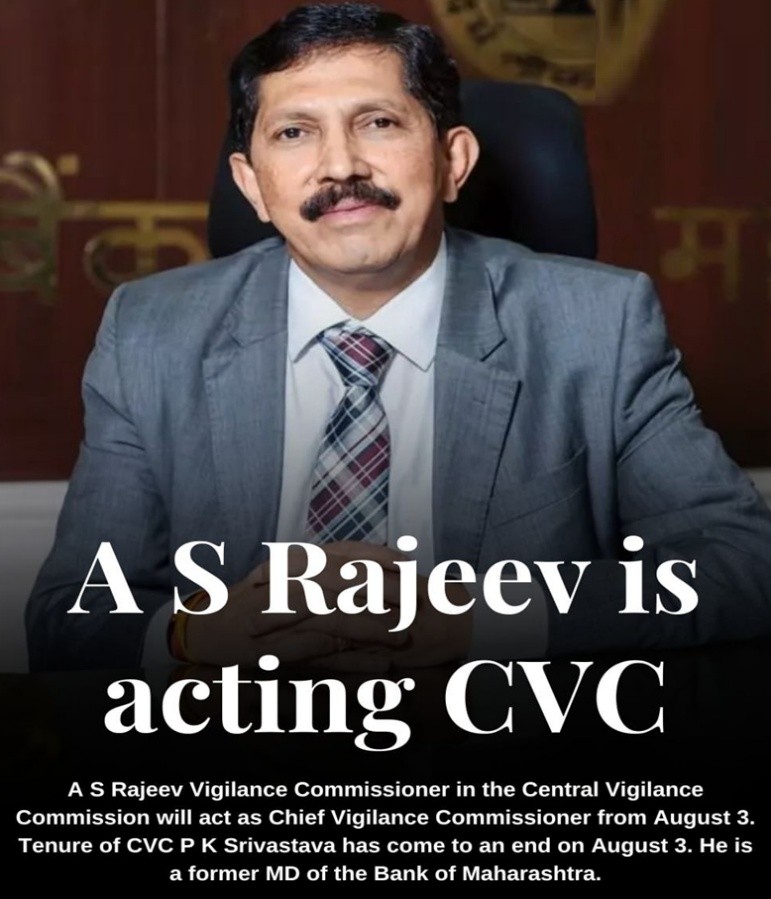
S. Rajeev - Acting Central Vigilance Commissioner
August 12 , 2026
20 hrs 0 min
9
0
- The President of India authorized Vigilance Commissioner A. S. Rajeev to act as the Central Vigilance Commissioner (CVC).
- He succeeded Praveen Kumar Srivastava, whose tenure ended on that date.
- A notification from the Department of Personnel and Training (DoPT) under the Ministry of Personnel, Public Grievances and Pensions was issued in this regard.
- Central Vigilance Commission (CVC) was set up as an executive body by the Government of India Resolution on 11 February 1964.
- It was on the recommendations of the Committee on Prevention of Corruption, headed by K. Santhanam.
- It aims to address governmental corruption.
- In 2003, the Parliament enacted a law conferring statutory status on the CVC. It has the status of an autonomous body, free of control from any executive authority.
- It was charged with monitoring all vigilance activity under the Central Government of India, advising various authorities in central Government organizations in planning, executing, reviewing, and reforming their vigilance work.
- The CVC is not an investigating agency: the only investigation carried out by the CVC is that of examining Civil Works of the Government.

Leave a Reply
Your Comment is awaiting moderation.