

PREVIOUS
✖
SC on creamy layer
March 14 , 2026
14 hrs 0 min
15
0
- The Supreme Court ruled that income cannot be the sole criterion to decide the creamy layer among Other Backward Classes (OBCs).
- It settled the long-pending question of equivalence between PSUs and private sector employees and those in the government sector.
- Earlier, those included in the ‘creamy layer’ are not entitled to OBC reservation benefits.
- Now, the Supreme Court’s judgement will be applicable to children of parents working at PSUs and in private employment.
- It provides relief to about 100 candidates who appeared in CSEs (Civil Service Exams) since 2015 and had been denied the OBC quota.
- A bench of Justices P.S. Narasimha and R. Mahadevan affirmed that social status, rather than just a salary, must be the primary measure for identifying the “creamy layer”.
- The Bench was hearing petitions arising due to a letter issued by the Department of Personnel and Training (DoPT) with regard to the creamy layer criterion.
- It was clarifying an Official Memorandum (OM) issued long back in September 1993.
- The court noted that the OM excluded income from salary and agricultural income from the income/ wealth test for determination of creamy layer status.
- That letter dated October 14, 2004 directed inclusion of salary income of PSU and private sector employees.
- This resulted in hostile discrimination between the wards of government servants and those of PSU/private sector employees.
- It was only on the basis of their income derived from salaries.
- So, treating the children of those employed in PSUs or private employment, etc., as being excluded from the benefit of reservation only on the basis of their income derived from salaries will not be correct.
- Without reference to their posts (whether Group A or B, or Group C or D) it would certainly lead to hostile discrimination between parties who are similarly placed.
- And it would amount to equals being treated unequally.
- Thereby it was attracting the rigour of the equality doctrine under Articles 14, 15 and 16.
Background
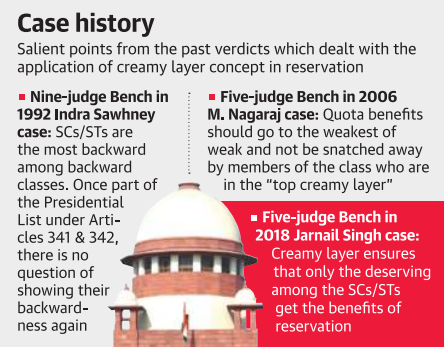
- Following the landmark 1992 SC ruling in Indra Sawhney vs Union of India, also known as the Mandal verdict, the concept of ‘creamy layer’ within the OBCs was introduced.
- The idea was to exclude certain categories of OBC candidates whose families had accumulated certain social and economic privileges over the years, known as the creamy layer.
- On September 8, 1993, the DoPT issued a circular clarifying who is classified as OBC and who belongs to the creamy layer among them.
- For those in government jobs, the ‘creamy layer’ specifies groups such as persons occupying constitutional posts; Group-A/Class-I officers of All India Services, Central services and state services; Group-B/Class-II services of Centre and state; employees of PSUs; officers of Armed Forces; professionals and those from trade and industry; property owners; and an income/wealth test.
- If either parent is a direct recruit of Group-A, or is promoted before the age of 40, their children cannot take advantage of the OBC quota.
- Similarly, if both parents are Group-B direct recruits, their children will be covered under the creamy layer.
- For Armed Forces, officials up to the rank of Lieutenant Colonel can avail the OBC quota, but higher ranks are in the creamy layer.
- The criterion for those not in the government sector was set at Rs 1 lakh per annum in 1993.
- It was revised in due course and since 2017, this income limit is Rs 8 lakh.
- In the September 1993 circular, it was categorically stated that income from “salary” or “agriculture” would not be counted for the test of income and wealth for deciding the creamy layer status.
- But in cases of EWS, this was “included.”

Leave a Reply
Your Comment is awaiting moderation.