

PREVIOUS
✖
Solar Energy Installation Slowdown
November 24 , 2026
13 hrs 0 min
4
0
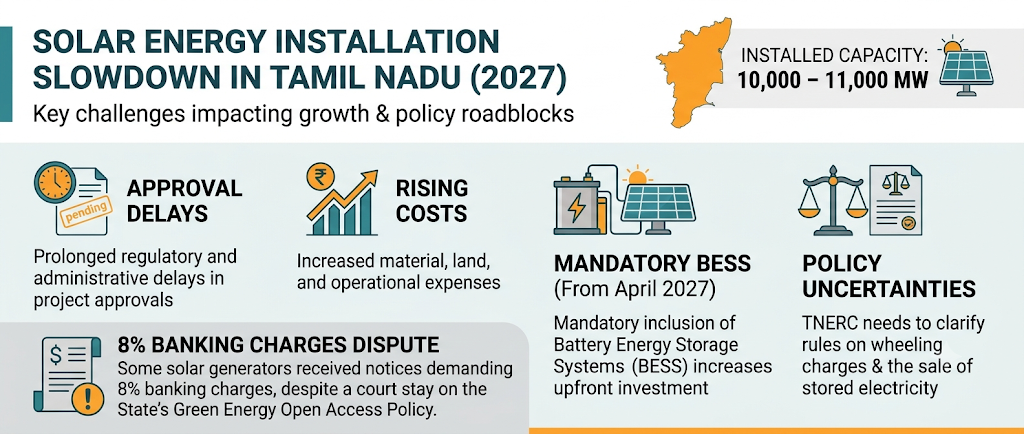
- Tamil Nadu may see a slowdown in new solar energy installations in 2027 due to approval delays, rising costs and policy-related issues.
- Tamil Nadu has an installed solar energy capacity of around 10,000–11,000 MW (Megawatts).
- Delays in project approvals, rising costs and the mandatory inclusion of BESS (Battery Energy Storage System) from April 2027 may slow down new installations.
- The TNERC (Tamil Nadu Electricity Regulatory Commission) needs to clarify provisions of the State's BESS policy, including rules on wheeling charges and the sale of stored electricity.
- Some solar energy generators received notices demanding 8% banking charges, despite the court staying the State's Green Energy Open Access Policy.
- The single window system for obtaining approvals is not functioning effectively, finer details based on the recently-announced Battery Energy Storage System (BESS) Policy should be notified by the Tamil Nadu Electricity Regulatory Commission, and costs are escalating.
- From April next year, it is mandatory for all new projects to have BESS, and this will push the costs up.
- The single window approval system is functioning effectively for solar energy projects that come as a part of foreign direct investments.
- The others require multiple approvals, starting right from the rural local body heads.
- These lead to delays, pushing up the costs.
- While the BESS policy is a welcome move, the Tamil Nadu Green Energy Corporation should ensure that stored solar energy is evacuated within 24 hours, so that the generator can store freshly generated energy the next day.
- More sub-stations and solutions for right of way challenges to lay lines on lands belonging to various government departments are among the other issues faced by investors that threaten to slow down solar energy projects.

Leave a Reply
Your Comment is awaiting moderation.