

PREVIOUS
✖
Sriharan Vacuum in Sattankulam Case
April 15 , 2026
13 hrs 0 min
29
0
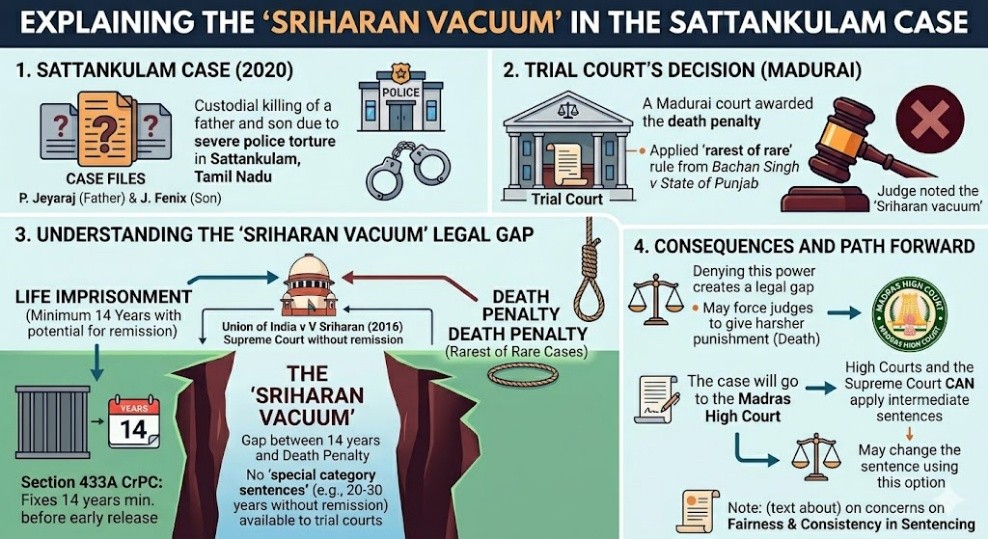
- A court in Madurai awarded the death penalty in the Sattankulam custodial death case, highlighting the “Sriharan vacuum”.
- The case involves the custodial killing of a father and son in 2020 due to severe police torture.
- The trial court applied the “rarest of rare” rule from Bachan Singh v State of Punjab to award the death sentence.
- Under Union of India v V Sriharan, trial courts cannot give fixed-term life imprisonment without remission (early release).
- Section 433A of the Code of Criminal Procedure (CrPC) fixes a minimum of 14 years for life imprisonment before remission.
- Because of this rule, the judge had only two options: life imprisonment (minimum 14 years) or the death penalty.
- This gap between 14 years and the death penalty is called the “Sriharan vacuum”, where no middle punishment is available to trial courts.
- The Supreme Court of India created “special category sentences” (like 20–30 years without remission) for serious crimes.
- But only higher courts like the Supreme Court of India and the Madras High Court can use this option, not trial courts.

Leave a Reply
Your Comment is awaiting moderation.