

PREVIOUS
✖
Tamil Nadu Budget 2026
February 19 , 2026
18 hrs 0 min
108
0
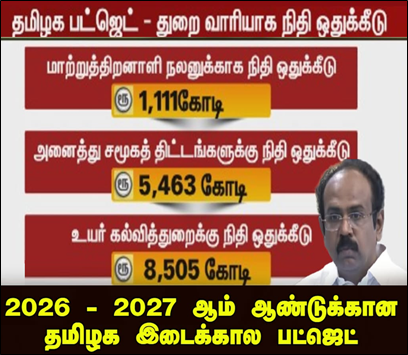
- The State’s interim Budget for the financial year 2026-2027 was presented in the Tamil Nadu Legislative Assembly by Finance Minister Thangam Thennarasu ahead of the Assembly elections due this year.
- Also, the interim Agriculture Budget was presented by the portfolio minister M.R.K. Panneerselvam.
- Tamil Nadu can achieve its trillion-dollar economy milestone by 2031 if it sustains the 2024-25 nominal growth rate of 16%.
- The finance minister will also present in the House the demand for advance grants for the year 2026-2027 and additional expenditure for 2025-2026 for its approval.
- Tamil Nadu recorded 11.3% economic growth in 2024–25.
- Gross State Domestic Product (GSDP) reached ₹31.19 lakh crore, retaining its position as India’s second-largest State economy.
- School Education was allocated ₹48,534 crore.
- Works of Periyar E.V. Ramasamy translated into 27 languages, including English, French, Arabic, Hindi, and Gujarati.
- In the Revised Estimates 2025-26, the outstanding debt of the State is estimated to be ₹9.52 lakh crore as against ₹9.29 lakh crore in the Budget Estimates 2025-26.
- The outstanding debt has been estimated to be ₹9.42 lakh crore in the Revised Estimates and ₹10.62 crore in the Interim Budget Estimates 2026-27.
- The State plans to borrow ₹1.79 lakh crore during 2026-27 and make repayment of ₹60,413.42 crore.
- The debt-to-GSDP ratio is estimated to be 26.12.
- According to the Interim Budget Estimates, the Revenue Deficit for 2026-27 is estimated at ₹48,696.32 crore.
- It was ₹69,219 crore in the Revised Estimates 2025-26 as against ₹41,635 crore in the Budget Estimates 2025-26.
- The Fiscal Deficit in the Interim Budget Estimates 2026-27 is estimated to be ₹1.21 lakh crore.
- It was ₹1.24 lakh crore, as per the Revised Estimates 2025-26.
- The Fiscal Deficit as a percentage of GSDP is estimated to reduce from 3.48% in the Revised Estimates 2025-26 to 3% in the Interim Budget Estimates 2026-27.
- 130 Comprehensive Emergency Obstetric and Newborn Care Centres (CEmONC) are functioning across the State to reduce maternal and neonatal mortality.
- Tamil Nadu ranks first in the country in terms of the number of safe deliveries conducted in Government hospitals.
- Tamilnadu’s Maternal Mortality Ratio (MMR) has dropped to 35 per lakh live births, and the Infant Mortality Rate (IMR) stands at 12 per thousand live births.
- Both are significantly lower than the national average.
- Tamil Nadu remains India's second-largest state economy.

Leave a Reply
Your Comment is awaiting moderation.