

PREVIOUS
✖
Tamil Nadu Prisons (Release on Furlough) Rules, 2026
February 22 , 2026
12 hrs 0 min
16
0
- The State government has notified new rules governing the release of convicts on furlough.
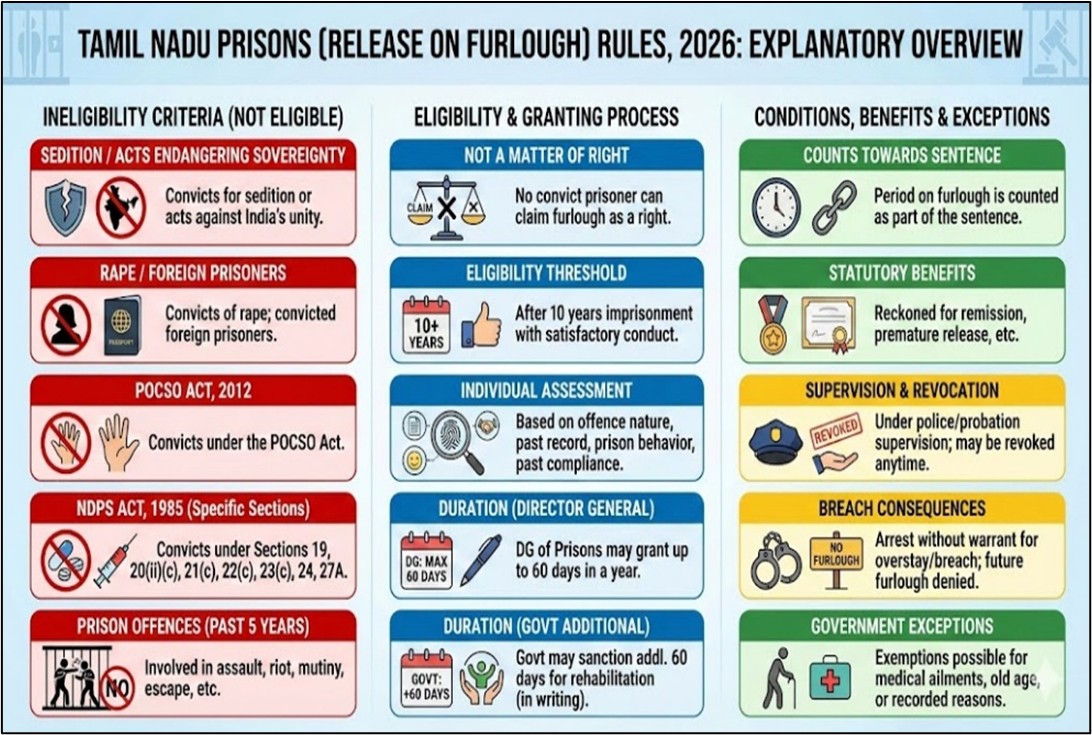
- Under the new rules, prisoners convicted for sedition/acts endangering the sovereignty, unity, and integrity of India are ineligible for furlough.
- Prisoners convicted of rape and convicted foreign prisoners are ineligible for release on furlough.
- Prisoners convicted under the Protection of Children from Sexual Offences (POCSO) Act, 2012, are not eligible for furlough.
- Prisoners convicted under Sections 19, 20(ii)(c), 21(c), 22(c), 23(c), 24, and 27A of the Narcotic Drugs and Psychotropic Substances (NDPS) Act, 1985 are not eligible for furlough.
- Prisoners involved in prison offences such as assault, outbreak, riot, mutiny, and escape during the past five years are ineligible for furlough.
- The rules state that no convict prisoner shall claim furlough as a matter of right.
- A convict prisoner becomes eligible for furlough only after completing 10 years of imprisonment with satisfactory conduct.
- Eligibility for furlough will be assessed individually based on the nature of the offence, past criminal record, behaviour in prison, and compliance during earlier temporary release.
- The Director General of Prisons may grant furlough for a period not exceeding 60 days in a year.
- The State government may sanction an additional 60 days of furlough in a year for rehabilitation reasons, to be recorded in writing.
- The period spent on furlough shall be counted towards the sentence of the convict prisoner.
- The furlough period shall be reckoned for remission of sentence, premature release, and other statutory benefits wherever applicable.
- The convict prisoner shall remain under the supervision of police or probation officers during the furlough period.
- Furlough may be revoked at any time by the Director General or the government.
- In case of overstay or breach of conditions, the prisoner may be arrested without warrant and denied furlough in the future.
- The government may exempt any person from the provisions of these rules in cases of medical ailments, old age, or other recorded reasons.

Leave a Reply
Your Comment is awaiting moderation.