

PREVIOUS
✖
USA national security strategy 2025
December 11 , 2025
15 hrs 0 min
4
0
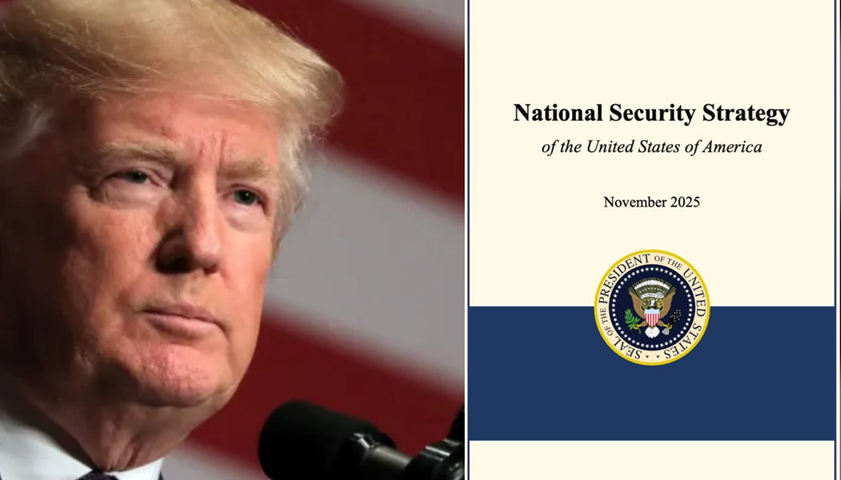
- The Trump administration finally released its much-anticipated National Security Strategy (NSS).
- U.S. Presidents usually release a National Security Strategy in each White House term.
- The last, released by Joe Biden in 2022, prioritized winning a competitive edge over China while constraining a "dangerous" Russia.
- Compared to the first-term NSS issued in December 2017, the new document is noticeably shorter and far more focused on MAGA-oriented.
- “America First” priorities that significantly narrow the scope of what the US defines as its core national interests.
- It laid out a radical realignment of U.S. foreign policy.
- It is shifting the longtime superpower's focus from global to regional.
- It is criticising Europe as facing "civilizational erasure" and putting a top priority on eliminating mass migration.
- It elevates Latin America to the top of the US agenda in a sharp reorientation from longstanding US calls to focus on Asia to face a rising China.
- It was breaking with decades of attempts to be the sole superpower.
- The strategy said that the "United States rejects the ill-fated concept of global domination for itself."
- It said that the United States would also prevent other powers, namely China, from dominating.
- But it added "This does not mean wasting blood and treasure to curtail the influence of all the world's great and middle powers."
- The strategy called for a "readjustment of our global military presence to address urgent threats in our Hemisphere," starting with migration.
- "The era of mass migration must end," the strategy said.
- The strategy made clear that the United States under Mr. Trump would aggressively pursue similar objectives in Europe, in line with far-right parties' agendas.
- It seeks an end to the Ukraine war.
- The strategy accused Europeans of weakness.
- The strategy speaks in bold terms of pressing US dominance in Latin America, where the Trump administration has been striking alleged drug traffickers at sea, intervening to bring down leftist leaders including in Venezuela, and loudly seeking to take charge of key resources such as the Panama Canal.
- The strategy cast Mr. Trump as modernizing the two-century-old Monroe Doctrine, in which the then young United States declared Latin America off-limits to rival powers.
- The strategy paid comparatively little attention to the Middle East, which has long consumed Washington.
- It was a U.S. priority for Israel to be secure, but stopped short of the fulsome language on Israel used even in the first Trump administration.
- On China, the strategy repeated calls for a "free and open" Asia-Pacific region but focused more on the nation as an economic competitor.
- After much speculation on whether Trump would budge on Taiwan, the self-ruling democracy claimed by Beijing, the strategy made clear that the United States supports the decades-old status quo, but called on allies Japan and South Korea to contribute more to ensure Taiwan's defense from China.
- The strategy predictably puts little focus on Africa, saying the United States should transition away from "liberal ideology" and an "aid-focused relationship" and emphasize goals such as securing critical minerals.
- It set out Trump’s foreign policy vision as one of “flexible realism” and said U.S. policy would be driven above all by “what works for America”.
- It is also noting New Delhi's strategic importance to Washington and identifying India as a key partner in global security and strategic initiatives.
- The intent is to deepen cooperation with New Delhi across economic, technological and defence sectors.
- It has dropped any reference to denuclearising North Korea as a goal.
- It was fuelling speculation that Washington may be angling to boost the chances of a diplomatic breakthrough with Pyongyang (North Korea) in 2026.

Leave a Reply
Your Comment is awaiting moderation.