

PREVIOUS
✖
Water Bankruptcy Report 2026 - United Nations University (UNU-INWEH) report
February 4 , 2026
14 hrs 0 min
24
0
- The United Nations published a landmark report on global water bankruptcy in January 2026.
- It was titled “Global Water Bankruptcy: Living Beyond Our Hydrological Means in the Post-Crisis Era.
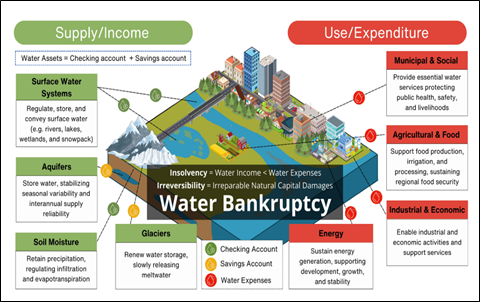
- It defines ‘water bankruptcy’ as a condition in which repeated crises become chronic states, with persistent shortages or damages, meaning that many water systems can no longer return to their historical baselines.
- The report states that water bankruptcy is a condition “defined by both insolvency and irreversibility”.
- Insolvency refers to withdrawing and polluting water beyond renewable inflows and safe depletion limits.
- Irreversibility refers to the damage to key parts of water-related natural capital, such as wetlands and lakes, that makes restoration of the system to its initial conditions infeasible.
- The UN argues that many countries have entered their ‘water system overdrafts’ through consistently overusing renewable water flows, which reduces the capacity of rivers and other watercourses to replenish themselves on normal timescales.
- More than half the world’s large lakes have declined since the early 1990’s, while around 35 per cent of natural wetlands have been lost since 1970.
- Nearly three-quarters of the world’s population live in countries classified as water-insecure or critically water-insecure.
- Around four billion people experience severe water scarcity for at least one month each year.
- The world has lost roughly 410 million hectares of natural wetlands in the last five decades—an area almost the size of the European Union.
- India has only 4% of global freshwater resources.
- Per capita water availability has declined by 73% since 1951 in India.
- The Indo-Gangetic Plain is identified as a hotspot for severe groundwater depletion.
- Many Indian cities face "Day Zero" (total depletion) scenarios.
- ‘Day zero’ is a term that is commonly used to refer to the point at which a city or other location runs out of water entirely.
- It was popularised during the Cape Town water scarcity crisis in 2018
- Tehran in Iran is now in its sixth consecutive year of drought.

Leave a Reply
Your Comment is awaiting moderation.