

PREVIOUS
✖
World Heritage Week 2026 – November 19/25
November 23 , 2026
12 hrs 0 min
11
0
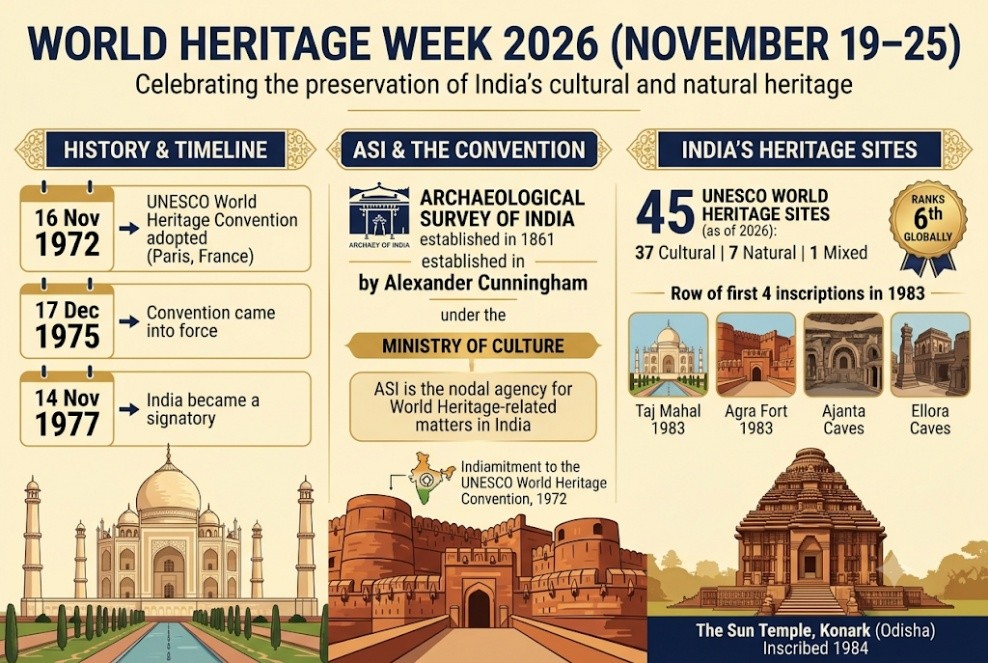
- The observance aims to create awareness about the preservation and conservation of India's cultural and natural heritage.
- India celebrates World Heritage Week as part of its commitment to the UNESCO World Heritage Convention, 1972.
- The convention was adopted on 16 November 1972 in Paris, France, and came into force on 17 December 1975.
- India became a signatory to the convention on 14 November 1977.
- The Archaeological Survey of India (ASI), established in 1861 by Alexander Cunningham, is the nodal agency for World Heritage-related matters in India.
- ASI functions under the Ministry of Culture and is responsible for the conservation and maintenance of centrally protected monuments.
- As of 2026, India has 45 UNESCO World Heritage properties: 37 cultural, 7 natural and 1 mixed.
- India ranks sixth globally and second in the Asia-Pacific region in terms of the number of UNESCO World Heritage properties.
- India's first four World Heritage inscriptions in 1983 were Agra Fort, Ajanta Caves, Ellora Caves and the Taj Mahal.
- The Sun Temple, Konark (Odisha) was inscribed on the UNESCO World Heritage List in 1984.

Leave a Reply
Your Comment is awaiting moderation.