

PREVIOUS
✖
AI and Maritime Security Priorities
November 3 , 2026
12 hrs 0 min
15
0
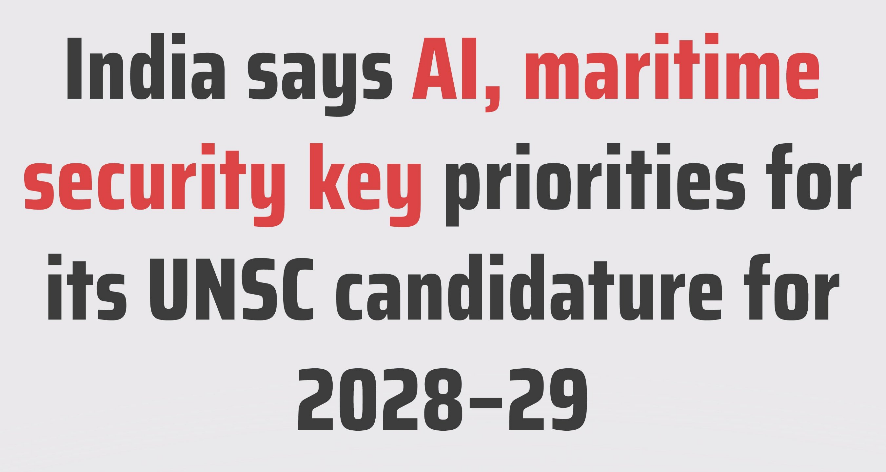
- India identified Artificial Intelligence (AI) and maritime security as key priorities for its candidature for a non-permanent United Nations Security Council (UNSC) seat for 2028–29, during a UN debate.
- AI-based analysis of satellite images, radar and vessel-tracking data can improve maritime awareness, detect suspicious activities and support search-and-rescue operations.
- India highlighted cyber threats to ports, ships, communication networks and undersea infrastructure and called for human oversight and safeguards for autonomous systems.
- India stressed freedom of navigation, lawful maritime trade and the safety of seafarers under international law, including the United Nations Convention on the Law of the Sea (UNCLOS).
- The Information Fusion Centre–Indian Ocean Region (IFC-IOR) is hosted by the Indian Navy in Gurugram, Haryana.
- It was launched in December 2018 to promote maritime information-sharing and security.
- India’s maritime cooperation approach follows SAGAR (Security and Growth for All in the Region).
- India and Tajikistan are competing for the Asia-Pacific Group’s single non-permanent UNSC seat, with elections scheduled for June 2027.
Leave a Reply
Your Comment is awaiting moderation.