

PREVIOUS
✖
Anaemia Mukt Bharat Strategy
October 30 , 2026
15 hrs 0 min
53
0
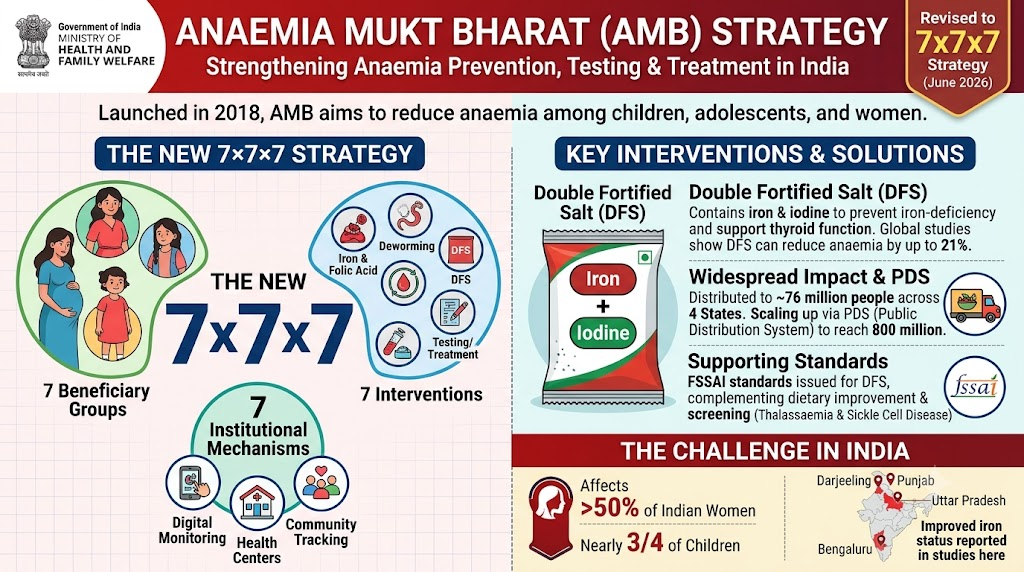
- The Government of India revised the Anaemia Mukt Bharat (AMB) programme to a 7×7×7 strategy in June 2026 to strengthen anaemia prevention, testing and treatment.
- It was launched in 2018 by the Ministry of Health and Family Welfare.
- AMB aims to reduce anaemia among children, adolescents and women; its traditional 6×6×6 strategy covers six beneficiary groups, six interventions and six institutional mechanisms.
- The revised 7×7×7 strategy covers seven beneficiary groups, seven interventions and seven institutional mechanisms, including iron and folic acid supplementation, testing and treatment, deworming, awareness and digital monitoring.
- Double Fortified Salt (DFS) contains iron and iodine to help prevent iron-deficiency anaemia and iodine-deficiency disorders; iodine supports normal thyroid function and growth.
- Anaemia affects over half of Indian women and nearly three-fourths of children; studies in Bengaluru, Darjeeling, Punjab and Uttar Pradesh reported improved iron status, while a global review found that DFS can reduce anaemia by up to 21%.
- Government programmes distribute DFS to about 76 million people across four States; wider distribution through the PDS (Public Distribution System), which serves around 800 million people, remains uneven.
- The FSSAI (Food Safety and Standards Authority of India) has issued DFS standards; DFS complements iron supplementation, dietary improvement and screening for thalassaemia and sickle cell disease.

Leave a Reply
Your Comment is awaiting moderation.