

PREVIOUS
✖
Anti defection law issue in Tamil Nadu
May 16 , 2026
30 days
629
0
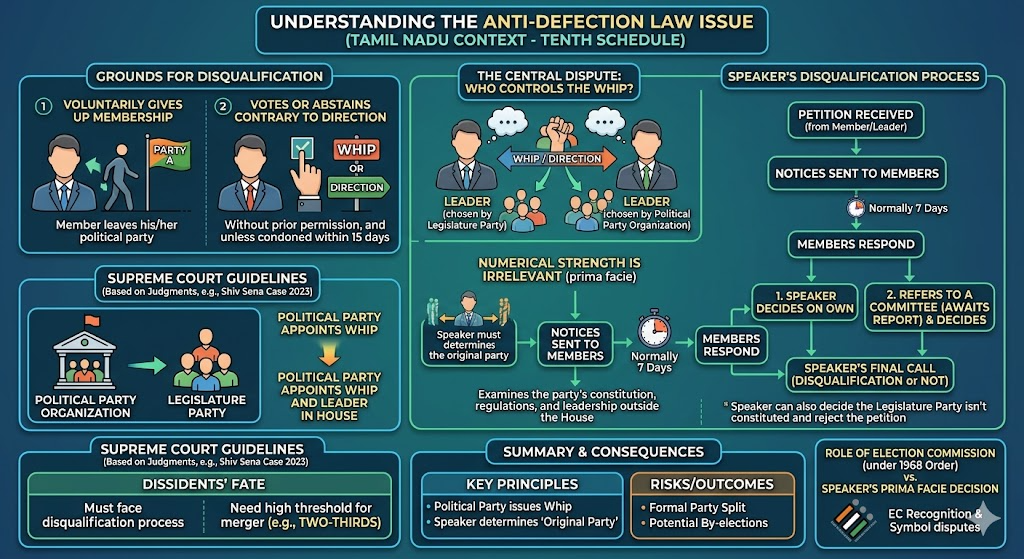
- As per the Tenth Schedule of the Constitution and the Members of the Tamil Nadu Legislative Assembly (Disqualification Ground of Defection) Rules, 1986, there are two grounds for disqualification in the event of defection.
- When a member voluntarily gives up membership of his or her political party and when a member votes or abstains from voting contrary to any direction issued by his or her political party.
- Over the years, different judicial pronouncements have been given and, in some cases, judgments have differed from each other.
- Palaniswami is of the view that he, being the general secretary of the party, had appointed his colleague-former Minister “Agri” S.S. Krishnamurthy, as the whip of the legislature party and the latter, in turn, conveyed through e-mail, registered post and SMS, about the line to be pursued by the legislators in the Assembly on the trust motion.
- He claims the AIADMK’s legislative party has been constituted with him at the helm.
- He also contends that written consent has been secured from all the legislators with regard to his election as the leader of the legislature party.
- However, the opposite camp dismisses Mr. Palaniswami’s account of events and asserts that no election has taken place.
- It also demands that the resolution with regard to the appointment of the leader and the whip be made public.
- On the contrary, that group has nominated persons for different posts in the legislature party.
- If Mr. Palaniswami gives a petition to the Speaker requesting him to initiate disqualification proceedings, Mr. Prabhakar can set the process in motion by sending notices to the legislators concerned.
- Ordinarily, seven days will be provided to such members for giving their comments.
- Upon the receipt of the members’ responses, the Speaker can either decide on his own or refer the matter to a committee and await the panel’s report, after which he can take a final call.
- Else, the Speaker can conclude that the AIADMK’s legislature party has not yet been constituted and may not take cognisance of the petition, if any, given by the Palaniswami camp.
- Palaniswami will have to decide whether to seek the disqualification of those who voted against him.
- The 10th Schedule gives a political party the option of condoning such a vote within 15 days.
- In 2017, he did not seek action against 11 AIADMK legislators of the O. Panneerselvam faction when they voted against him.
- A related question is whether a whip was issued and received by all members of the AIADMK.
- It remains to be seen whether Mr. Palaniswami is going to cite the second scenario, which appears to be a straightforward instance of defection.
- In September 2017, the then Assembly Speaker P. Dhanapal referred to the first scenario while disqualifying 18 AIADMK MLAs for having given representations in the previous month to Governor Vidyasagar Rao, expressing their lack of confidence in Mr. Palaniswami, who was the Chief Minister.
- The Supreme Court verdict in Subash Desai vs. Principal Secretary to the Governor, delivered in May 2023, deals squarely with the fate of dissident legislators who are numerically larger than the MLAs loyal to the original party leadership.
- A key ruling in the judgment is that it is the political party and not the legislature party that appoints its whip and gives the direction to vote in a particular manner or abstain.
- Therefore, any claim by another faction that it has its own whip and its own direction to vote cannot be countenanced by the Speaker.
- The second principle in the judgment is that the numerical strength of respective factions is irrelevant.
- However, the Court also recognised that the Speaker may have to determine which of the two factions constitutes the original party, and he may examine the party’s own constitution and other regulations that spell out its structure.
- The structure of leadership outside the House is also a relevant consideration.
- The Speaker’s determination on which group constitutes the party is only a prima facie finding, and would not have any impact on the Election Commission’s power to adjudicate the question under Paragraph 15 of the Election Symbols (Reservation and Allotment) Order, 1968.
- That order deals with the recognition of parties and the allotment of symbols.
- A key question is whether the dissidents have incurred disqualification under the anti-defection law.
- The camp led by Mr Palaniswami cites the Supreme Court’s judgement in the Shiv Sena case of May 2023, wherein the Court addressed one of the issues which is of relevance to Tamil Nadu.
- In Maharashtra, too, conflicting whips were issued by rival groups to members of the Shiv Sena.
- Eventually, the Court held that “to hold that it is the legislature party which appoints the Whip would be to sever the figurative umbilical cord which connects a member of the House to the political party.”
- It concluded that “the political party, and not the legislature party, appoints the Whip and the Leader in the House.”
- Under the rules governing the question of disqualification in the Assembly, each party has to submit a list of its members and designations within 30 days of the first sitting of the House.
- The appointment of a member as the Whip, as well as the existence of a ‘direction’ to the members on the manner of voting (the word ‘whip’ is not used in the Tenth Schedule) and its communication to all members, will all be questions of fact that may require adjudication.
- If he seeks the rebels’ disqualification, the move may lead to a formal split in the party, and may result in byelections that would lead to further marginalisation.
- On the other hand, even if he doesn’t, the other faction, led by former ministers S.P. Velumani and C. V. Shanmugam, may gain the upper hand within the party structure.
- However, what stands in his favour is that the dissidents are in no position to save themselves from disqualification, as they do not have the requisite two-thirds strength to claim that they have merged with another party.
- The 2023 judgment of a Constitution Bench on related questions arising from the anti-defection law is also not in their favour.

Leave a Reply
Your Comment is awaiting moderation.