

PREVIOUS
✖
Chennai's Industrial Map
August 30 , 2026
11 hrs 0 min
15
0
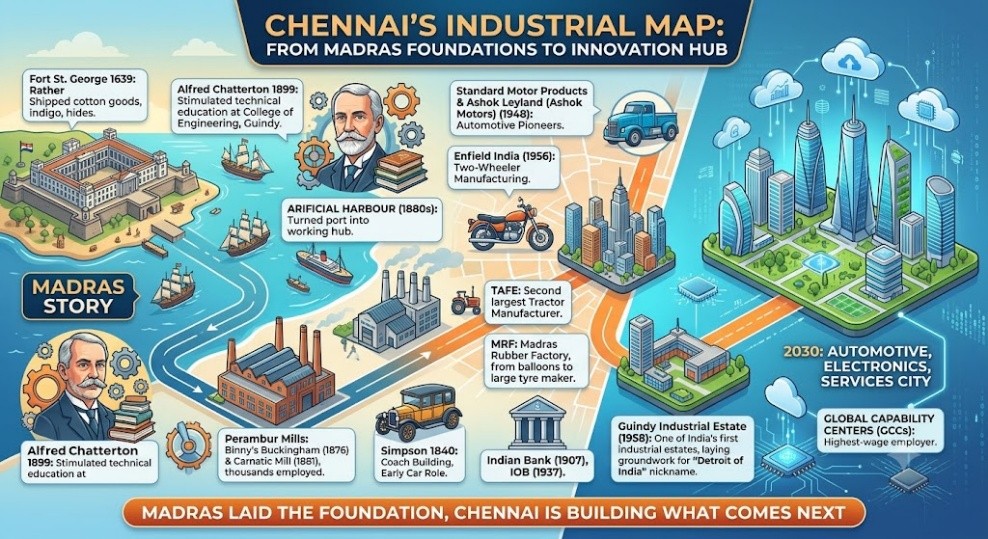
- It was Madras — a city whose business story was already taking shape several centuries ago.
- The industrial development of the Madras Presidency was a matter of serious concern and in 1899.
- Alfred Chatterton, who was then with the College of Engineering in Guindy, was appointed to stimulate industrial technical education in the region.
- From Fort St. George in 1639, Madras shipped rather than made — cotton piece goods, indigo, hides.
- The artificial harbour of the 1880s turned an open roadstead into a working port.
- Binny’s Buckingham Mill in 1876 and the Carnatic Mill in 1881 employed tens of thousands at Perambur.
- Simpson began coach building in 1840.
- Long before Chennai became known as the Detroit of India, Madras was already laying the foundations for the automotive sector.
- The first car to arrive in Madras was in the early 1900s. Simpson’s, the city’s famed coach builders then, played a role in this.
- In 1948, Madras had become home to automotive pioneers such as Standard Motor Products of India and Ashok Leyland (Ashok Motors).
- While Enfield India began two-wheeler manufacturing in 1956.
- Tractors and Farm Equipment Ltd (TAFE), headquartered in Chennai, is the second largest tractor manufacturer.
- The Madras Rubber Factory, known as MRF, began its journey in Madras as a small toy-balloon manufacturer and went on to become one of India’s largest tyre makers.
- Indian Bank began its journey in Madras in 1907, followed by Indian Overseas Bank (IOB) in 1937.
- In 1958, Madras opened the Guindy Industrial Estate, one of India’s first industrial estates alongside Delhi’s Okhla.
- In 2030 Chennai is still an automotive, electronics, and services city, and GCCs remain its highest-wage employer.
- Madras laid the foundation and Chennai is building what comes next.
Leave a Reply
Your Comment is awaiting moderation.