

PREVIOUS
✖
Constitutional recognition - Denotified tribes
February 8 , 2026
260 days
635
0
- Denotified tribes, nomadic tribes, semi-nomadic tribes seek ‘separate column’ in 2027 caste census.
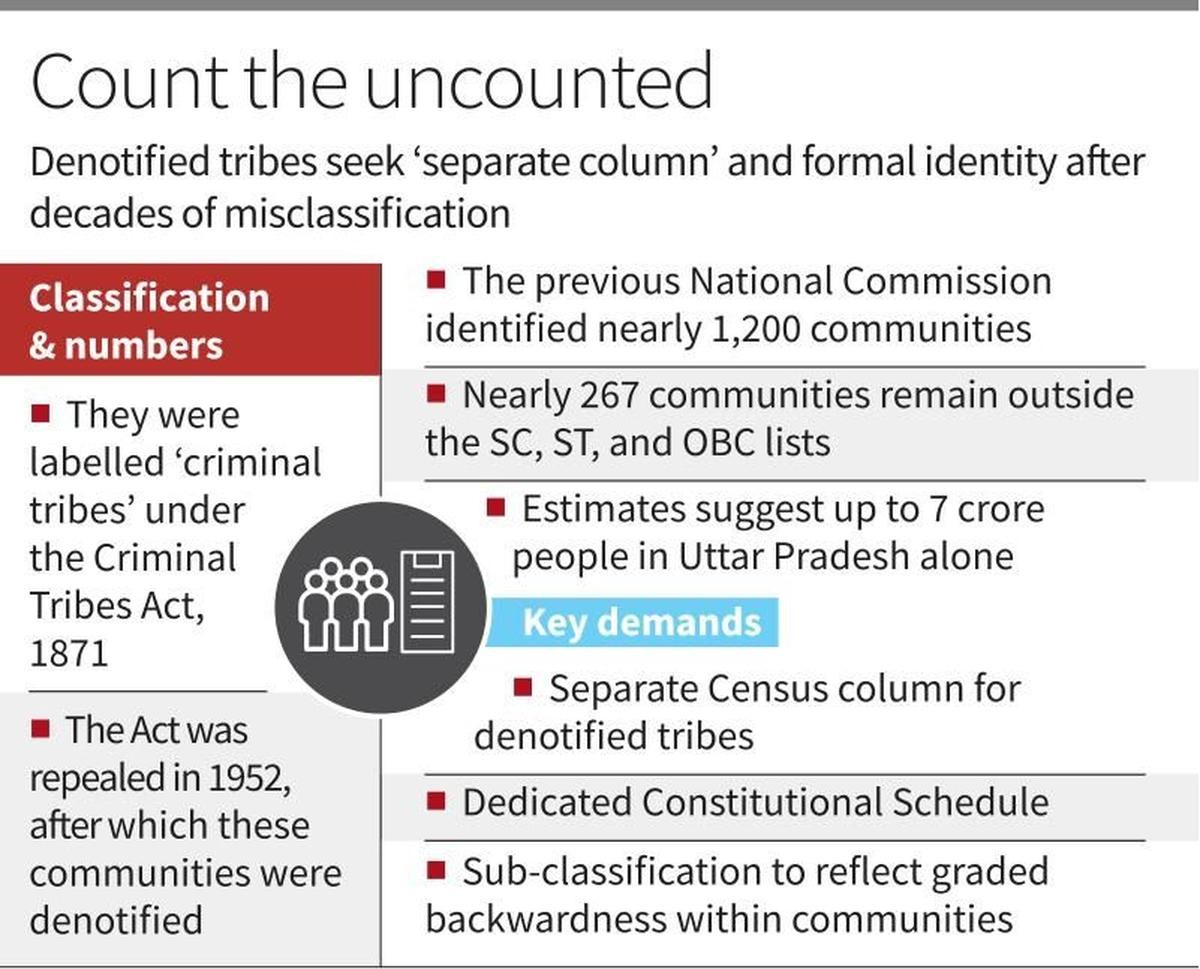
- They are claiming they have been politically misclassified among SC, ST, OBC groups.
- They want sub-classification to highlight backwardness within grouping.
- Their demand is for constitutional recognition of the Denotified Tribes in a Schedule, on par with the existing classifications of Scheduled Castes and Tribes (SCs/STs) and other backward classes (OBCs).
- In February 2027, India will conduct a caste enumeration for the first time since 1931.
- Five years after that 1931 Census, the origins of the Scheduled Castes list came into being in the form of the Government of India (Scheduled Castes) Order, 1936.
- In 1871, a colonial law had classified entire communities, particularly nomadic and semi-nomadic tribes, as “criminals”.
- After the law was repealed in 1952, these groups became known as “Denotified” tribes.
- The Social Justice Ministry has now recommended to the Office of the Registrar General of India that these Denotified, nomadic, and semi-nomadic tribes be included in the upcoming Census.
- The Criminal Tribes Act was first enacted in 1871 and then amended in 1924, before being officially repealed on August 31, 1952.
- The 1871 Act said it was for the “registration, surveillance and control of certain criminal tribes and eunuchs”.
- It was describing “criminal tribes” as “tribe, gang, or class of persons” that are “addicted” to committing non-bailable offences.
- After the Act was repealed in 1952, the communities notified as “criminal” under the law had become “denotified”.
- Thus, they are coming to be known as the denotified, nomadic, and semi-nomadic tribes (DNTs).
- The last National Commission for DNTs, headed by Bhiku Ramji Idate, identified 1,200 such tribes.
- Most of them have been assimilated in the SC, ST, or OBC classifications over the last seven decades.
- In its 2017 report, however, the Idate Commission, also listed about 267 DNT communities that have not been classified as such.
- The scheme SEED is aimed for the welfare of these communities.

Leave a Reply
Your Comment is awaiting moderation.