

PREVIOUS
✖
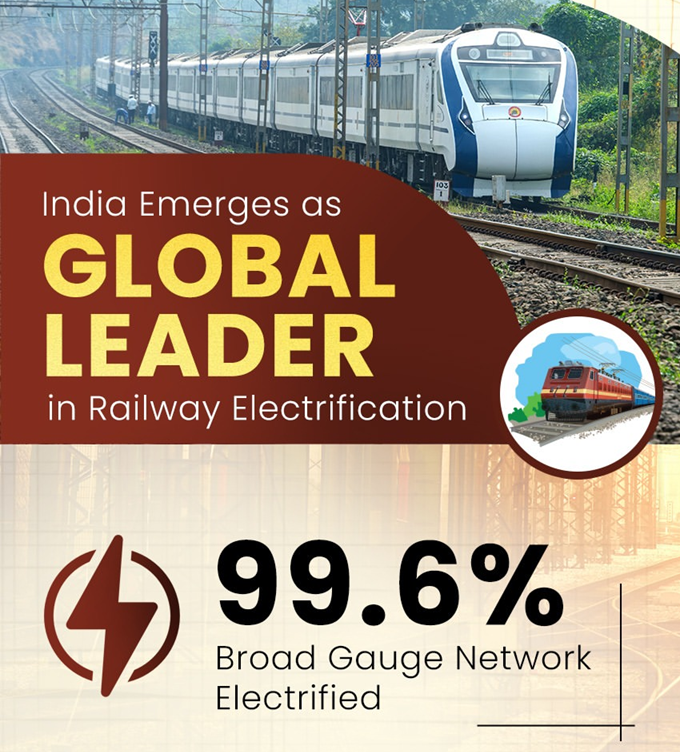
Global Leader in Railway Electrification
July 29 , 2026
65 days
410
0
- India emerges as Global Leader in Railway Electrification with 99.6% Broad Gauge Network Electrified.
- India is second only to Switzerland.
- It is ahead of several major railway networks, including China (82 per cent), Spain (67 per cent), Japan (64 per cent), France (60 per cent) and the United Kingdom (39 per cent).
- Rail transport emits about 11.5 grams of carbon dioxide per tonne-kilometre, nearly 89 per cent lower than road transport, which emits around 101 grams.
- Electrification has also reduced Indian Railways’ dependence on imported fossil fuels.
- Apart from environmental benefits, electric traction has improved operational efficiency by enabling higher hauling capacity, faster train speeds and reduced travel time.
- Across railway zones, 15 zones, including Central, Northern, Eastern, Western, South Central and East Coast Railways, along with Konkan Railway and Kolkata Metro, have already achieved 100 per cent electrification.
- At the state level, several states and Union Territories, including Andhra Pradesh, Bihar, Madhya Pradesh, Uttar Pradesh, Gujarat, Maharashtra, Odisha, Telangana, Punjab and Delhi, have achieved complete railway electrification.

Leave a Reply
Your Comment is awaiting moderation.