

PREVIOUS
✖
Governor’s Role in a Hung Assembly
May 12 , 2026
117 days
816
0
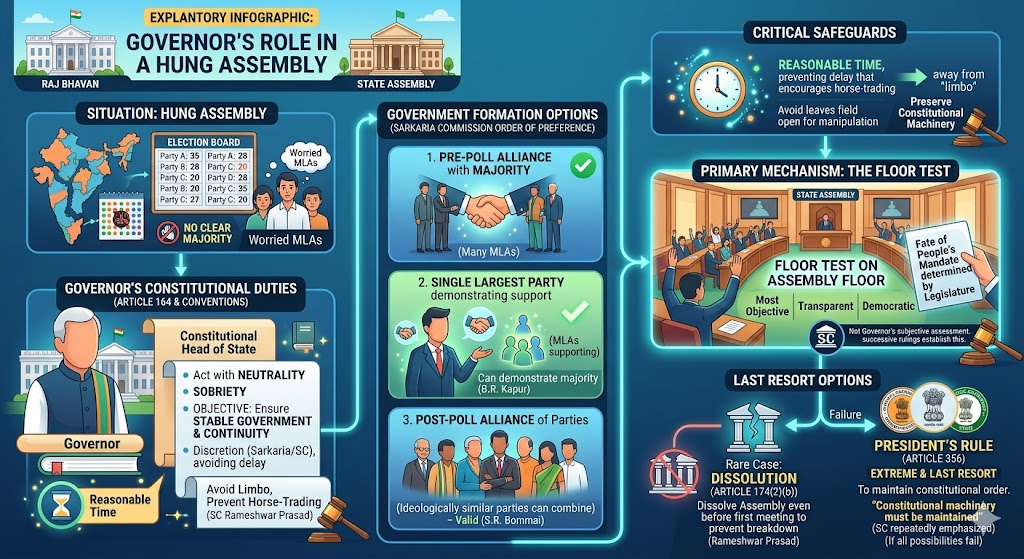
- Under Article 164 of the Constitution, the Governor appoints the Chief Minister, but there is no fixed constitutional procedure for selecting a Chief Minister in a hung Assembly.
- Constitutional conventions require the Governor to act with neutrality, sobriety, and the objective of ensuring a stable government.
- The Governor, as the constitutional head of the State, is primarily responsible for ensuring continuity of constitutional governance and political stability.
- The Sarkaria Commission, the Committee of Governors appointed after the November 1970 Conference in New Delhi, and the Supreme Court conventions state that the Governor’s personal bona fides are irrelevant in decision-making.
- The Governor must explore all possible options by consulting political parties, coalitions, and independent MLAs within a reasonable time to enable government formation.
- The Constitution does not define “reasonable time,” but Governors cannot delay indefinitely, as such delay may encourage horse-trading and political instability.
- The Governor’s duty is to act to preserve constitutional machinery in the State and avoid breakdown of governance.
- If all possibilities fail, the Governor may recommend President’s Rule under Article 356 as a last resort to maintain constitutional order.
- The Governor cannot remain in limbo, neither appointing a government nor dissolving the Assembly without constitutional justification.
- The Supreme Court in B.R. Kapur (2001) and Rameshwar Prasad (2006) held that a Governor may dissolve a Legislative Assembly under Article 174(2)(b) even before its first meeting in rare cases to prevent constitutional breakdown.
- The Governor must avoid leaving the field open for manipulation or delay that undermines the electorate’s mandate.
- The Sarkaria Commission (1988), later endorsed by the Supreme Court, laid down a clear order of preference for government formation.
- First preference is to invite a pre-poll alliance that has a clear majority in the House.
- Second preference is to invite the single largest party that can demonstrate the ability to form a stable government.
- The third preference is a post-poll alliance of parties that can collectively demonstrate majority support.
- The use of post-poll alliances has become more common due to coalition politics and fragmented mandates.
- The Supreme Court in S.R. Bommai (1994) held that the Constitution does not require that a government must necessarily have a pre-formed majority at the time of appointment.
- Ideologically similar parties may form post-poll alliances to secure a majority in the House, which is constitutionally valid.
- If none of the options result in a stable government, the Governor may recommend President’s Rule, but only as an extreme and last resort measure.
- The Supreme Court has repeatedly emphasized that “constitutional machinery in the State should, as far as possible, be maintained.”
- The Committee of Governors also concluded that testing majority support should normally be done on the floor of the Assembly.
- Though S.R. Bommai included observations limiting floor tests to situations where an incumbent Chief Minister is alleged to have lost majority, later judgments expanded its use.
- Successive Supreme Court rulings have established the floor test as the most objective, transparent, and democratic method to determine majority support.
- Courts have stressed that the fate of the people’s mandate must not depend on the Governor’s subjective discretion.
- The Supreme Court has repeatedly ordered floor tests to resolve disputes over majority, whether for existing or incoming governments.
- The floor test has become the primary constitutional mechanism to ensure stability and prevent misuse of discretionary power.
- The Court has affirmed that the legislature, not the Raj Bhavan, is the true forum where democracy is exercised.
- Ultimately, the decision on who governs must be determined on the floor of the House, not by the Governor’s personal assessment.

Leave a Reply
Your Comment is awaiting moderation.