

PREVIOUS
✖
IMD Climate Study
November 13 , 2026
17 hrs 0 min
36
0
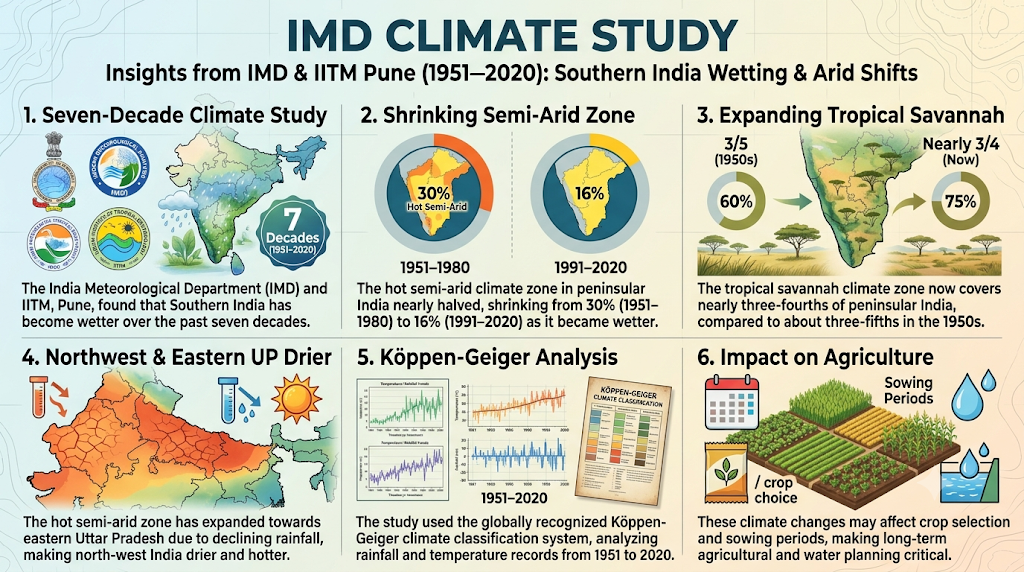
- A study by the India Meteorological Department (IMD) and Indian Institute of Tropical Meteorology (IITM), Pune, found that Southern India has become wetter over the past seven decades.
- The hot semi-arid climate zone in peninsular India nearly halved from 30% (1951–1980) to 16% (1991–2020).
- The tropical savannah climate zone now covers nearly three-fourths of peninsular India, compared to about three-fifths in the 1950s.
- In contrast, the hot semi-arid zone has expanded towards eastern Uttar Pradesh due to declining rainfall, making north-west India drier and hotter.
- The study used the Köppen-Geiger climate classification system and rainfall and temperature records from 1951 to 2020.
- These climate changes may affect crop selection and sowing periods, making long-term agricultural and water planning important.

Leave a Reply
Your Comment is awaiting moderation.