

PREVIOUS
✖
NITI Aayog report on school education system
May 16 , 2026
140 days
686
0
- NITI Aayog released a policy report titled ‘School Education System in India: Temporal Analysis and Policy Roadmap for Quality Enhancement’.
- It is a policy document that presents a comprehensive, decade-long analysis of India's School Education System across key parameters such as access and enrolment, infrastructure, equity and inclusion, and learning outcomes.
- It draws on secondary data from UDISE+ 2024-25, PARAKH Rashtriya Sarvekshan 2024, NAS 2017 and 2021, and ASER 2024.
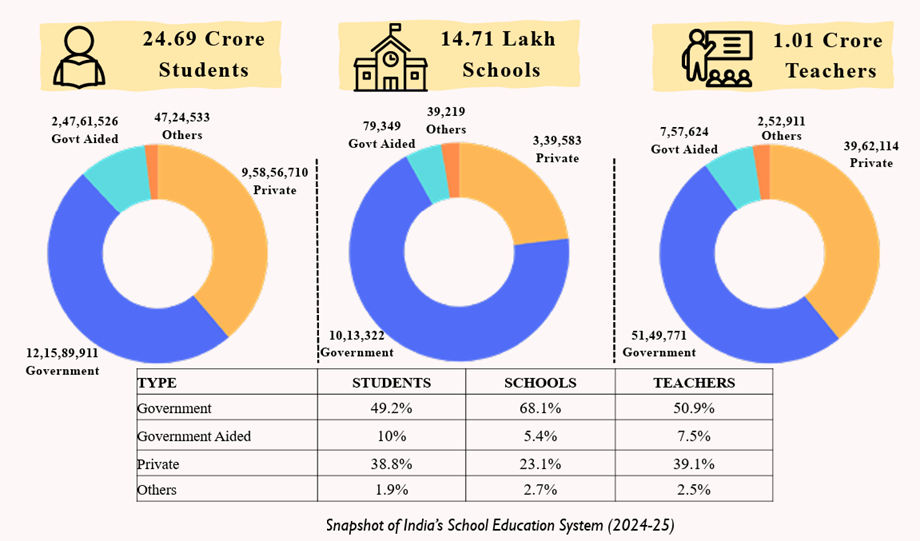
- India's school education system today spans 14.71 lakh schools, serving over 24.69 crore students, making it the largest system in the world.
- While there are about 7.3 lakh primary schools, there are only around 1.64 lakh higher secondary schools.
- Four out of every 10 children who enter the system drop out before completing higher secondary education.
- It means only 5.4% of schools offer a continuous journey from Grade 1 to 12.
- Close to 7,993 schools across the country reported zero student enrolment.
- The highest numbers were seen in West Bengal (3,812) and Telangana (2,245).
- The report recommends ‘Cylindrical’ Schooling to fix the “leaky pipeline” of student dropouts, which involves creating composite schools that cover Grades 1-12 under one roof.
- The report highlights that, according to UDISE+ 2024-25, 1.19 lakh schools lack access to functional electricity.
- Access to water and hygiene facilities is also inconsistent.
- The share of schools with drinking water facilities has increased from 96.5% in 2014 to 99% in 2025, but 14,505 schools still lack functional water sources, and nearly 59,829 lack hand-washing facilities, compromising student health and hygiene.
- Improving learning outcomes in children and responsible use of Artificial Intelligence (AI) are challenges that need to be tackled in the school education system.
- The report points to the fact that the Right to Education Act ends at age 14, leaving families to bear the costs of tuition, books, and transport for older children.
- The report noted that India’s current 4.6% GDP allocation to education remains below the 6% target first recommended in 1964.

Leave a Reply
Your Comment is awaiting moderation.