

PREVIOUS
✖
Passive Euthanasia Case
March 13 , 2026
228 days
705
0
- The Supreme Court of India allowed withdrawal of life-sustaining treatment for Harish Rana, a 32-year-old man in a vegetative state since 2013, marking the first court-approved implementation of passive euthanasia in India.
- The bench of J. B. Pardiwala and K. V. Vishwanathan permitted withdrawal of medical treatment, including clinically assisted nutrition.
- The Court directed All India Institute of Medical Sciences to implement palliative end-of-life care ensuring dignity and comfort.
- Medical boards formed by the Court concluded that his condition was irreversible with negligible chances of recovery.
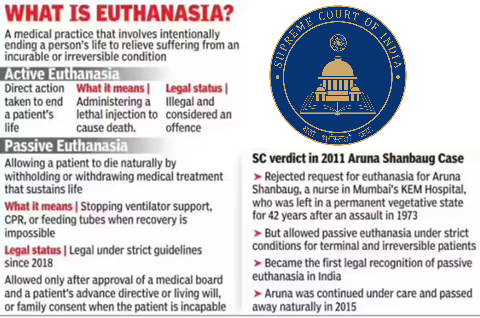
- Passive euthanasia means withdrawing or withholding life-sustaining treatment, while active euthanasia (assisted dying) remains illegal under the Bharatiya Nyaya Sanhita.
- The legal basis comes from Article 21 of the Constitution of India, which the Court interprets as including the right to die with dignity.
- Earlier judgments such as Aruna Shanbaug case and Common Cause v. Union of India laid the framework for passive euthanasia in India.

Leave a Reply
Your Comment is awaiting moderation.